


Your browser doesn't support audio playback.
This conversation originally aired in the Aug. 2, 2026 episode of Inside Appalachia.
A new memoir explores the struggle to stay in Appalachia – and the struggle to leave.
Virginia writer Emilee Hackney has a complicated relationship with her home. She loves the place where she’s from, in Tazewell County – her friends, family, the swimming holes and mountains and wild places – but she also felt stifled. Her new memoir, All That’s Unseen: An Appalachian Memoir, explores this tension and her experience when she did leave.
Inside Appalachia Host Mason Adams recently spoke with Hackney.

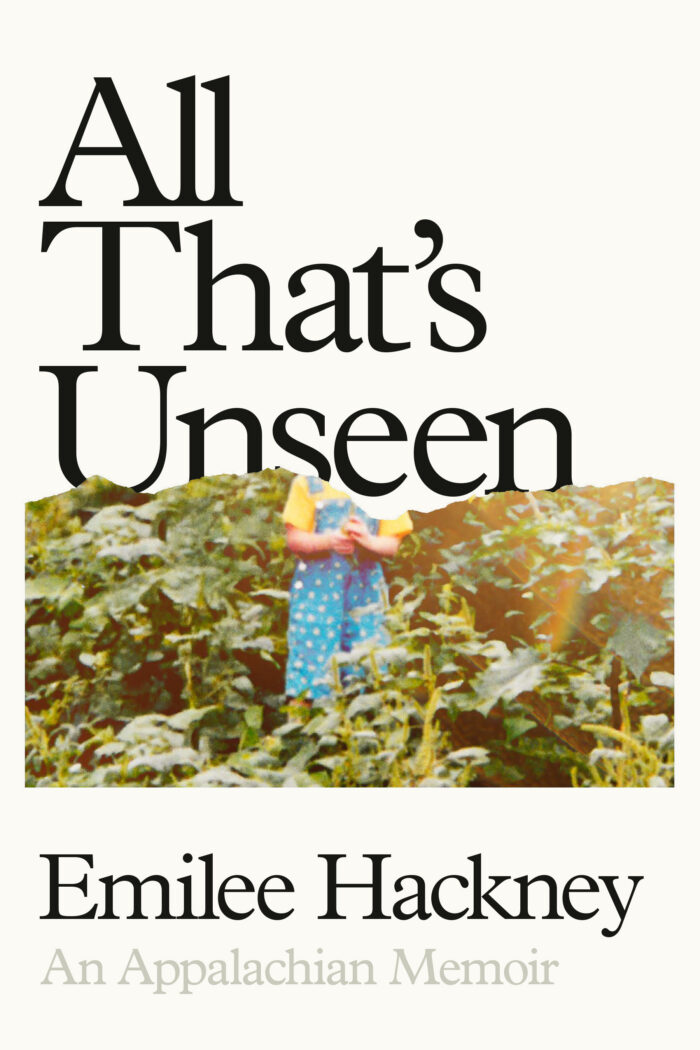
Courtesy of Penguin Press
Adams: Emilee Hackney, thank you so much for coming on Inside Appalachia.
Hackney: Well, thank you for having me. I love Inside Appalachia and I’m thrilled to talk to you.
Adams: All That’s Unseen is about a lot of things. But in a lot of ways, it seems to be about your relationship with your home community in Tazewell County, Virginia. I’d love to hear your thoughts on your relationship with Appalachia and how it’s changed over the years?
Hackney: Appalachia was all I knew for the first 20 years of my life. I mean, that’s where I live, that’s where I grew up. And then I ended up moving away to Harvard. I transferred to Harvard, and I was 20 years old as a sophomore. That winter I came home for break and — it’s kind of like the saying, “You never step into the same river twice.” I came home and things felt different. I had this sense of unbelonging that just kind of grew stronger and stronger as I returned to Harvard and then came back home and kind of bounced back and forth between the two.
When I came home that summer for break, I was back for three months. I got a job at WVVA, which is a news station. And even though I was really involved in the community again, I felt very much an outsider. Because people started to think strange things of me because I’d gone to Harvard and come back. I had a dentist appointment, and my dentist was like, “You don’t talk like that when you’re up at Harvard?” He was just kind of blown away that I still had my same accent, even though it was the accent I’ve always had.
So, it seemed like people thought that Harvard would have changed me in a really drastic way in just the few months that I’d been attending. And then, you know, I’d go back up to Harvard and I’d be really homesick, but then I’d come back home and just feel like I didn’t belong, and so I felt like I was caught in this middle ground for a long while — and maybe still am.
Adams: Do you live in Appalachia now?
Hackney: I live in Nelson County. I think that’s right on the border of Appalachia. I don’t think Nelson County’s Appalachia because it’s south of Albemarle [County], and Albemarle’s not in [Appalachia,] I don’t think.
Adams: It’s not in the Appalachian Regional Commission, but it’s in the mountains. You’re still in the Blue Ridge which I consider for part of Appalachia. At least geographically.
Hackney: It feels like it to me. That’s another in-between murky area — like is it Appalachia and is it not? Which I guess that’s kind of metaphorical, right? I’m in this strange in-between space.
Adams: All That’s Unseen really does live up to its subtitle, An Appalachian Memoir. And that’s the part that struck me the most, but it’s also being categorized as a book about religion and spirituality. So, can you share a little bit about your journey into Pentecostalism and back?
Hackney: Yeah, I started attending this Pentecostal church when I was 5 years old because my mother took me and my brother. There was a Pentecostal church that had been very close to our house, so my mom started taking us. And like most kids, I was very uninterested in church.
But then as I got older, as I became a teenager, I guess the teachings of the church started to really impact me and I started to become very concerned about the rapture, and dying and going to hell because that was what was preached. You know, if you’re not saved and 14- to 15-year-old me was like, “Oh my gosh, I’m not saved. I’m going to go to hell.” So it became a very big concern, and I got very deeply involved in the church after that, through my adolescence, until I got involved with an older guy and we attended church together. He ended up not being the person that I thought he was, and after our relationship fell apart, I really relied heavily on my church. But then I found out that a lot of our church friends were siding with him, even though he’d done this really terrible thing.
And I became disenchanted with religion, with the religion that I had grown up in and been so involved in. After that I left the church. I didn’t have anything to do with it after that. I just felt very betrayed by it and it just was not what I thought it was all those years.

Courtesy
Adams: A lot of people in Appalachia face a similar situation — at least as far as their relationship to their home communities, and this question of whether to leave for college or work. So, what words do you have for those young people?
Hackney: A lot of times, even if you want to leave, or you feel that leaving is an option, it’s kind of difficult, right? Because if your family is rooted in Appalachia and has been rooted in Appalachia for a long time, like mine was, it almost doesn’t make sense to leave.
It doesn’t occur to you — or it didn’t occur to me for a long time, for the first 20 years of my life. It’s like, why would I want to leave? Everything I know is here. This is comfortable. This is what I know. This is home. And it wasn’t really until pretty drastic circumstances of me being betrayed by my fiance and having to leave my church — until that happened, I really hadn’t considered leaving. I had no reason to. But I’m really glad that I chose to and that the opportunity presented itself to me — that it occurred to me to try to apply to a four-year university. It can be very beneficial and enriching, and even if it’s only for a few months, to live somewhere different, somewhere completely different than the mountains or away from your support system — that forces a kind of new growth. And it’s not comfortable. It wasn’t for me at all. It’s really difficult and lonely and isolating, I think.
But because of that, I feel like you have a broader perspective and — I don’t know — maybe come to appreciate where you came from even more than you would have if you’d never left. If anybody has the opportunity to, they should take it or try to make it happen if at all possible, even if it’s just for a short while.
Adams: One of my favorite moments in the book is when you start to get curious, and people had discouraged you from looking outside, and you had assumed a lot of those doors were closed. I feel like that’s a shared assumption across a lot of Appalachia by young people and otherwise — is that “I’m from this small town. There’s nothing happening here. Nobody’s going to be interested in what I have to offer. I’m not from a big city.” But when you started to scratch a little bit, you found that maybe those doors weren’t as closed as you thought.
Hackney: Definitely. I almost felt like I’d been sold a lie or something. In high school I don’t remember being encouraged to really even apply to college. It was like, well, “You can get a scholarship at community college or if you’re feeling really ambitious, maybe move an hour and a half east to Virginia Tech.” You know? But there was no talk of like these bigger colleges or just bigger places to be. It wasn’t really encouraged. And even when I first got accepted to Harvard, I had people that were telling me, “It’s going to be so hard.”
I had somebody tell me they only accepted me because I was going to fill a diversity box, which I thought was very mean. But I also kind of believed it a little bit. I was like, “What in the world would they want with me from Tazewell County, Virginia?” Like, what do I have to offer?
So I guess I moved up there and had that in mind while I was living there, and then I was I was amazed that people were interested in my story. At times, I felt pretty self-conscious about it, because some people were interested in it for what felt like voyeuristic purposes. Like, “Oh, Appalachia, oh Trump.” It felt like they they weren’t genuinely interested in me, or who I was as a person, or my experiences. They just wanted to hear this reaffirmation of the stereotypes that they thought were true about Appalachia, so it didn’t feel like a genuine interest.
But yeah, people were very interested in my story, and who I was and where I was from. I just never thought that that could be the case, because living in Appalachia, I just thought that, you know, “This is like the most boring place ever. Nothing ever happens. Nobody’s I have nothing to offer anybody outside of here.”
Adams: The book is extremely compelling, and it’s a page turner and I think you’re going to find a big readership. So, Emilee Hackney, thank you so much for coming on Inside Appalachia.
Hackney: Thank you, Mason.
--
All That’s Unseen: An Appalachian Memoir is out now. It’s available from Penguin Random House.