


Your browser doesn't support audio playback.
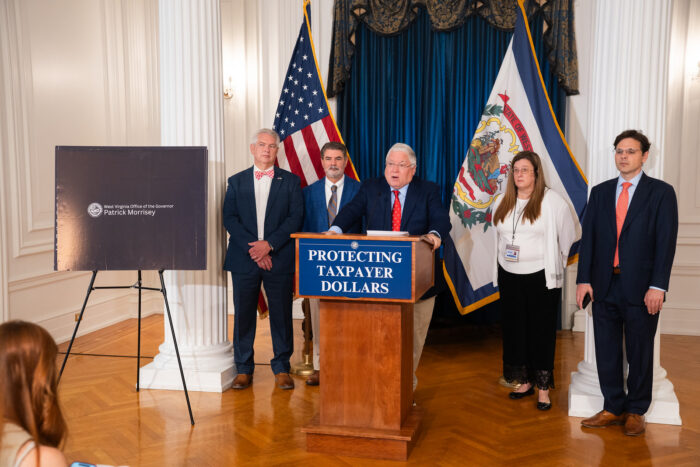
An audit of the Department of Human Services shows the Temporary Assistance for Needy Families (TANF) program with a deficit of $40 million, Gov. Patrick Morrisey said Monday.
“We uncovered some really challenging and problematic information,” he said during a press conference.
Pointing to a chart, Morrisey said the figures show a federal TANF grant of $100 million with spending projected to hit $140 million. The trouble began, he said, during the COVID-19 pandemic, when one-time monies were used to fund ongoing program costs.
“During COVID, we saw that there were significant funding increases that were used to dramatically increase and expand state programs, but unfortunately those one-time monies were used to permanently increase baseline expenditures,” Morrisey said. “There were a lot of these COVID programs, we inherited a lot of them that just were on autopilot, and they were building baselines with one-time monies. That’s irresponsible.”
TANF funds childcare, a School Clothing Allowance (SCA) and Food and Nutrition Services (FNS) for needy families.
“There are temporary carryover balances that help avoid this being a today problem, but those funds are shrinking quickly, and we have to address it,” Morrisey said. “The program can go on potentially for up to 18 months, but we have to now make the changes that are going to make sure that there are no structural deficits within TANF.”
The governor added that his office would confer with legislators before making any decisions about how to address the deficit.
The audit of the Department of Human Services is one of three conducted as part of a system-wide assessment of potential cost-cutting and savings opportunities that Morrisey called for during the beginning of his term.
The Departments of Transportation and Homeland Security have also been audited. Morrisey said all three audits have identified potential savings of up to $168 million by cutting expenses like unused cellphones and state vehicles, and reducing staffing turnover.