


Your browser doesn't support audio playback.
This conversation originally aired in the Nov. 8, 2026, episode of Inside Appalachia.
A new anthology collects science fiction, fantasy and horror stories from writers across Appalachia. It’s called, These Dreaming Hills: Dark and Wondrous Tales from Appalachia.
Inside Appalachia Producer Bill Lynch recently spoke with the anthology’s editor, Noah Ashley Blooms.
Blooms began the conversation by reading the introduction.
The transcript below has been lightly edited for clarity.

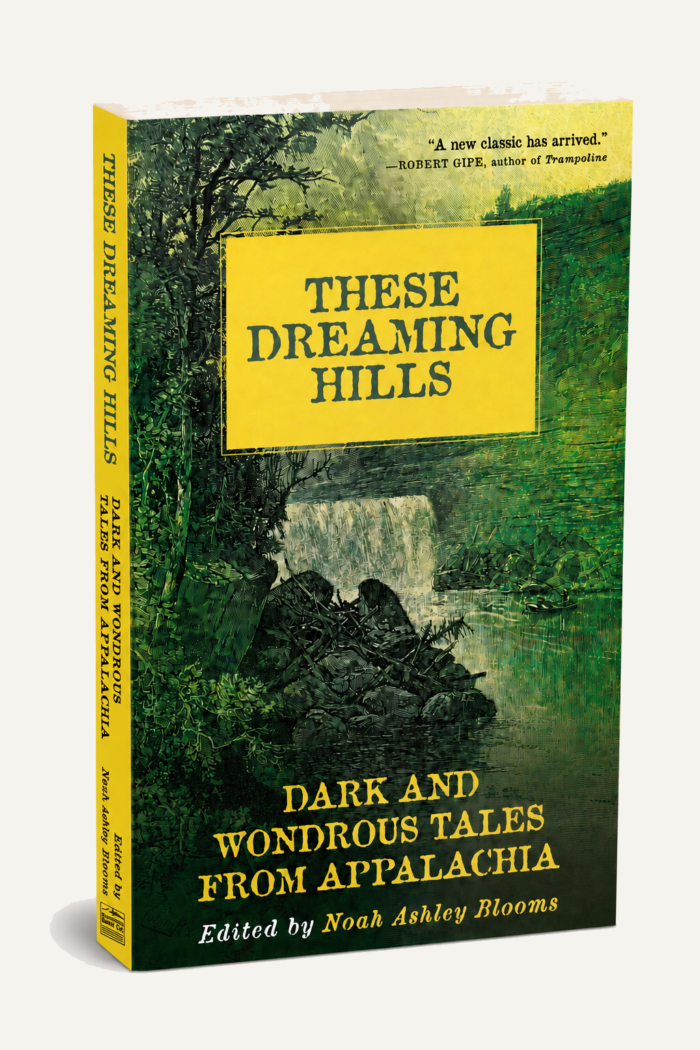
Courtesy of Appalachia Book Company
Blooms: (reading from the anthology’s introduction) “The Appalachia I know is a shapeshifter.
It changes depending on where you stand, what you believe, and which stories you bring with you. It is both home and the place you had to leave. Shelter and confinement. A sapling growing over reclaimed grass, its roots reaching into earth still scarred by mining. Traditions that preserve and expectations that stifle. City lights shining along ancient hillsides. College towns, river cities, farms, and hollers. It includes what many people expect — devout, white, and working class—as well as what is often overlooked: Black, Indigenous, Latine, queer, and disabled Appalachians. It is rural and urban, rooted and scattered, and more varied than any list could hold. Its communities are capable of profound care and profound harm. Belonging here is never only inherited; it can also be claimed, created, and remade.
Appalachia has never been one thing, though people have spent generations trying to make it so. The region has been called backward, isolated, resilient, pure, and doomed — often by people more interested in what Appalachia can symbolize than in the contradictory lives being lived within it. Each description may catch one aspect of the place, but none has yet contained the whole.
For years, I’ve tried to capture its transformative quality in my fiction by bringing speculative elements into Appalachian settings. Not because horror, fantasy or science fiction transform my home into something strange, but because they reflect the way I have often experienced it myself.”
Lynch: Speak a little about your contributors and where they’re all from and who they all are.
Blooms: It was very important to me when I stepped in. The submissions period had closed already, and one of the things that I’m always very aware of is trying to reflect diversity in the submissions, or at least the stories that are chosen.
You know, Appalachia gets still, I think, viewed as a predominantly white, cis-straight area with a lot of Christian believers in it, which is not untrue, but one of my goals was to show a larger extent of who lives here and who contributes to it.
That also includes folks who maybe were not born in Appalachia, but have chosen Appalachia as their home because it’s not just having lived here for seven generations that makes you an Appalachian.
There are a lot of folks who want to be here, and want to love this place. So, trying to make sure that as many voices as possible, especially in a collection that in itself is talking about speculative Appalachian fiction, which is not the dominant mode of Appalachian fiction.
Appalachian stories, I think, are more thought of as being literary realist in nature. So, in a collection of stories that is already kind of at the fringe of Appalachian literature, I wanted to make sure that the people who are telling the stories are also represented kind of across the spectrum.
So, we have folks of different races, ages, queer and trans folks who are telling stories and different geographic places — so, all across Appalachia, 11 different states.
Hopefully, it is as broad as I could possibly make it in order to capture what I think is a place that is not easy to pin down no matter how much we would like to be able to sum it up cleanly and clearly.
Lynch: What kind of differences are represented in the anthology?
Blooms: I think geographically and sort of the setting-wise, there are rural stories, but there are also more stories that are not set sort of just within rural or isolated places.
There are different genres. So, it’s horror, sci-fi, fantasy and stories that kind of range in between. We have stories about futuristic Appalachian settings where there are data centers sort of overcrowding everything — smoggy air and kind of fantastical technology where electricity is being rationed.
You have stories that are about inherited family magic being passed on from the older generation to the younger generation and kind of the tension in between that.
There are witches in the mountains and boys washing up behind after floods. There are oceans waiting behind mountains.
So, there’s also tonally, I think, a difference in it [the book]. There are stories that are sort of somber and reflective and ones that are more optimistic and future looking.
Hopefully, the goal was to give a breadth of both genre and tone and content and ideas to try to express as much as possible about such an enormous region.
Lynch: Do you think Appalachia is by nature spooky?
Blooms: I do.
I’m biased. I mean, I’ve always felt that way. I think my writing reflects that. My editorial sensibilities reflect that. I grew up in southeastern Kentucky, and I feel like there was a particular mixture of influences and forces.
I grew up in the Pentecostal Church where you could be filled with the Holy Ghost at any moment and suddenly, your body, your voice is transformed.
So, there was this kind of porousness in people. The boundary between who you are and what you believe was very thin.
The environment itself was full of stories. I had a lot of folks, I think in Appalachia, my family were oral storytellers. They shared a lot, especially about the history of the land. So, every place that I would drive by would have all of these layers of who used to live there and what happened to them and why they’re no longer there.
The environment too felt very laden with history and with story, often with a violent or unfinished tinge to it. So, even stories that weren’t necessarily scary were just incomplete, which I think invites a kind of imagination into it.
But yeah, there was this feeling of porousness and malleability and of boundaries being more suggestion than fact that I think invites in a kind of spooky sensibility, but also the isolation. The mountains themselves are imposing.
You’re miles and miles away from anybody in the dark. I think that will get anyone’s mind turning.
Lynch: I get that. So you kind of hit on these stories kind of popping up a lot in your background. Do you think that’s universal to Appalachia, that storytelling is just ingrained in the culture?
Blooms: I think it’s a very deep tradition. I’m sure there are places that would contradict it, but I think that it is something that I found over and over again. And in southeastern Kentucky, it was something that from the time that I was very small.
Like, even in our school system, it was encouraged. We had oral storytellers and folklorists and traditional musicians who would visit the school to try to help kind of bring that into the next generation.
So, I think there’s also a value of what came before and of history and of lineage that also lends itself to that, too — and families. I think it’s important to kind of self-mythologize and to have this understanding of who they are and where they came from and to create a kind of story within families.
--
These Dreaming Hills: Dark and Wondrous Tales from Appalachia is available from Appalachia Book Company.