


Your browser doesn't support audio playback.
Just across the Ohio River, the town of Marietta, Ohio played a pivotal role in the future of the United States and Ohio statehood – keeping the state free of slavery 60 years before the Civil War. But the vote passed by one vote.
Singer songwriters Larry Groce and Todd Burge have written a musical Called “One Vote! The Musical” that dives into that history. News Director Eric Douglas sat down with Groce to find out more.
This interview has been lightly edited for clarity.
Douglas: Tell me about this play. Tell me how this started.

Groce: It started six years ago, believe it or not. I read David McCullough’s book, “The Pioneers” like many people did. It was a best-selling book. He’s one of America’s best-selling historians. He went to Marietta because he was going to give a speech at the University of Ohio, and he realized he didn’t really know much about this whole area. So he did some research, and what he found, he said, “How come everybody doesn’t know this? Marietta influenced the history of America in ways that people don’t know.”
So we started talking about doing Marietta, the musical. Most people know it was the first city on the other side of the Ohio River, but that’s pretty much what they know. The people who settled Marietta were Revolutionary War officers, and they formed a company. They were capitalists. They formed a company to buy land from our new government.
We just had just won the war and we just settled with Britain, and what we got was, besides freedom for the colonies, we got this huge tract of land called the Northwest Territory, and what is it today? Ohio, Indiana, Illinois, Michigan, Wisconsin, and part of Minnesota. Pretty big amount of land. It was as big as the 13 colonies.
So they came up with this document called the Northwest Ordinance, very short document, but very important, because it guaranteed people who lived in this big territory a lot of the freedoms our Constitution does, due process of law, freedom of religion, freedom of speech, a lot of things like that. But here’s the catch, the big one, it guaranteed something that our Constitution does not guarantee, there would be no slavery in this territory.
Douglas: This was 70 years before the Civil War.
Groce: Correct. That’s the way it started. The Northwest Territory was slavery-free. The people that started the company, General Rufus Putnam, and two people who weren’t military, but they were people that were very much interested in settling and doing it the right way and keeping it free from slaves. They were Cutlers, Manasseh Cutler and his son Ephraim Cutler. They were dedicated to keep this land free of slavery. After they got enough people there, they decided it was time for Ohio to become a state. We’re all the way up to the 1800s, 1802 they have a constitutional convention. Ohio became a state in 1803 but they had to have a convention to write the laws for this state. These laws were going to override the Northwest Ordinance. They’re breezing through the Constitutional Convention until they get to the issue of slavery, and then there’s some pushback. Nobody wanted to get up and say “We want it to be a slave state,” even though some of them did.
They began to put in clauses into the Constitution that took away rights for black people, and so their sneaky way of doing it was to say, well, we’ll take away all their rights. Let’s let them be slaves until they’re 20. These guys said, “No, no, there’s no part-time slavery, and if black people don’t have rights, then they’re not like other people, and they might as well be slaves.” These guys fought in the Constitutional Convention, and it came down to one clause. It was really hard on the black people. It was going to take away a lot of their rights.
One of these guys, Ephraim Cutler, was sick. He was in his bed in his boarding house, and the vote was coming up, and if it passed, and black people would have no rights. They already took away the right to vote, but they’re going to take away all the other civil rights. Putnam, came in and said, “You got to get out of bed and go vote,” and Cutler said, “You think it’s going to be close?” He got out of bed and they rejected that clause by one vote. And that’s the name of our show, “One Vote! The Musical.”
I ask people, imagine for a moment what American history would be like if Ohio had been a slave state?
Douglas: It would have shifted a lot of things and shaped the future of the United States. I used the term play earlier, but this is a musical.
Groce: And we wrote the songs first, Eric. Me and Todd are not playwrights, so we started writing songs about events that we thought were pretty interesting, like the formation of this company, this company that bought the land and resold it was called the Ohio Company of Associates. It started in a bar in Boston, the bar called A Bunch of Grapes. So we have a song and a scene called it, “It Started at the Bunch of Grapes.”
Douglas: What’s the plan for this story?
Groce: The musical is being put on at the theater at Marietta College. Tickets are available now. You can buy them online at OneVotemusical.com. It’ll be July 17, 18 and 19. Friday and Saturday are evening shows at 7 p.m. Sunday is 2:30 in the afternoon, and the same thing the next week, July 24, 25 and 26.
If you were so inclined on the 16th, for $100 you can be the first to see the show at our dress rehearsal. Tickets are $25 normally.
Douglas: This is a premiere.
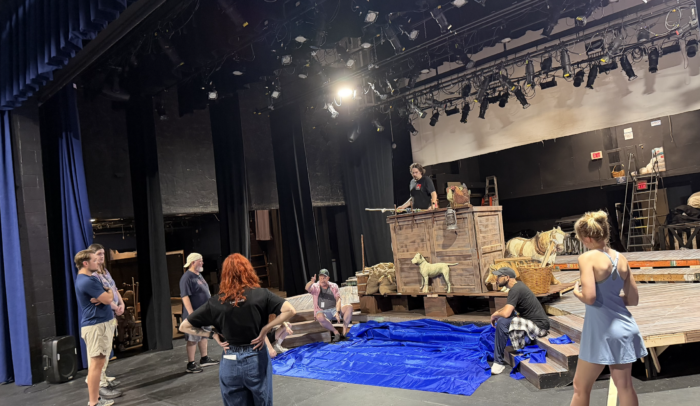
Groce: We’ve had to put together a company to do this. We’ve gotten help from a lot of directions. We got help from Marietta College letting us use their place, and their people, and theater people there have been very helpful.
We got help from our executive producing agency. Our 501 c3 home is the Northwest Territory Museum Society. Campus Martius Museum is part of that. Erin Augenstein, executive director of the society, is our partner. The Marshall Theater Department is playing a big part in this and we are supported by The Ohio Arts Council, America 250-Ohio and The Center for Appalachian Innovation.