


Your browser doesn't support audio playback.
This conversation originally aired in the Sept. 6, 2026, episode of Inside Appalachia.
Inside Appalachia Host Mason Adams spoke with country music star and Mountain Stage Host Kathy Mattea about her memories and thoughts on Dolly Parton’s passing.
The transcript below has been lightly edited for clarity.
Adams: When Dolly passed away, you posted on your Facebook page a few of your memories and you told one story about appearing on a TV show that Burt Reynolds hosted with Laurie Morgan, Tanya Tucker and Dolly Parton. Do you mind relaying that story?
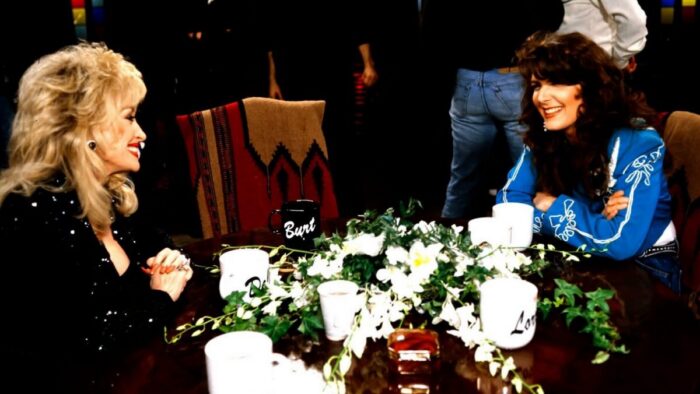
Mattea: So, I get a call one day that CBS is doing a prime-time network special for two nights. One night is “The Women of Country,” one night is “The Men of Country.”
At the time, Burt Reynolds was doing these interview shows. Around a round table, he would interview people from all different walks of life. I got asked to be part of it and I showed up. I had just gotten over bronchitis. And for the whole day of taping, periodically, I would just go into a coughing jag and couldn’t stop and then just have to stop the tape.
But at one point, Bert looks at Dolly and he says, “Will you sing our song?” Of course, “our song” was “I Will Always Love You.” And she said, “Yeah, I will — if she’ll play it for me.” I had a guitar with me, and I just started winging it.
In the early part, she calls the chords to me when I missed one and then I was kind of in after that. But I mean I am suddenly across a table, and Dolly Parton is singing to us. Not on a mic, not on a stage — just in the room. And when the chorus comes in, Lori and Tanya and I hit the harmony chords. And it was just a glorious moment in my life.
Adams: And then after the first chorus, she says, “I want to say this next part to you, and you, and you.” And she points at all of you. What did that feel like — in that moment, where you know she’s singing with you in mind personally?
Mattea: I think she had a gift for making everybody feel that way, whether she pointed it out or not. I mean, that sort of sense of really making sure you knew that she saw you. When she was talking to you, she was very present.
There was no like, “I’m being Dolly.” That was part of the mystique about her, was that she had such a big persona. You know, the wigs and the boobs and the makeup and the costumes and the tight clothes and all the stuff. But when she was with you, she was fully present with you. And so part of wrapping your brain around what it was like to be in her presence was that she seemed so artificial, and so completely real at the same time.
As I recall, in the moment, it just felt like the most normal thing for her to do in the world. But looking back, I’m like, “Oh my gosh, you know, how lucky am I?”
Adams: That part just gives me chills. And then you also shared the video for “Romeo,” which came out the next year and just has this murderers’ row of country music singers. It’s Dolly, of course, but Tanya Tucker, you, Mary Chapin Carpenter, Pam Tillis — and Billy Ray Cyrus. And it’s just a fun, funny video. I guess my question is, was that as fun to make as it is to watch?
Mattea: Oh, yeah. Of course, how could it not be? And there’s Dolly instigating all the fun. This is part of how she did her career. She doesn’t just sit on the sidelines and go, “Well, that Billy Ray Cyrus guy. He’s doing really good. Wow, look at him go.” She’s like, “I want some of that. I’m going to play in the sandbox with that guy.”
And she would just call people up and do projects like that. She wrote this whole song. I mean, it’s hard to describe right now if you weren’t there. But when Billy Ray came along, it was a phenomenon. There was no Garth [Brooks] yet, and he was huge like that out of nowhere. The fact that we all got to play on this cultural moment, and strut our stuff a little bit, and have a twinkle in our eye and wink at the audience — she instigated all of that and egged us on to really lean into it. And so we got to ride on Dolly’s coattails for a little bit.
Adams: You talked about Dolly wanting to “play in the sandbox.” And between her collaborations and just reinventing herself, it seems like she was in the zeitgeist in the national conversation for decades. How do you think she was able to accomplish that — and somehow never make enemies of anybody?
Mattea: First of all, she was really, really smart and a very shrewd business person. She said, “You know, I always want to be important.” And the way I interpreted that was, “I want to be relevant.” You know, I don’t want to just be a dinosaur. I want to be really in the conversation, in the now, as I am. And I think that was a real clear goal of hers.
And I think the reason she could do it is, she had the talent to back it up. You know, when she wrote “9 to 5” — that was a great pop song. I remember when it came out, just, “Oh my God, this is so good. I can’t stop singing it.” So she had the kind of talent that backed up what she was able to think about doing career-wise.
And I think also at that point she decided that if she was going to do this, she was going to do her best to not put anything in the world that anybody could push back on. It wasn’t that she didn’t stand up for what she believed in, but she would not jump on the bandwagon.
I was watching an interview the other night. It was of her in the early 1970s. When women’s lib was taking over. Women were burning their bras and making this whole statement. And everybody kept trying to figure out where Dolly sat in that conversation. So the guy said to her, “Well, you know this women’s lib thing is going on. And I heard that you burned your bra.” And she said, “Yes, I did. I burned my bra and it took the fire department three days to put it out.” And then she didn’t say another word.
So, she was very good at not giving you anything to hook into and what that left us is that everyone gets to see Dolly as the same as them. And that was maybe the most beautiful thing about her. That takes real vision to think, “That’s what I want to leave the world.” So, at this time of great polarization, she’s a unifying factor. I think we’re all beginning to see that in a new light because of trying to put into words what she meant to all of us.
Adams: You know, we’re Inside Appalachia. We cover this region. And in some ways, Dolly Parton was an ambassador from Appalachia to the world. So, when you look at Dolly, and in her career and her legacy, what did she mean for Appalachia?
Mattea: Oh, I think, you know, she was like our godmother. To be so huge worldwide and to still identify so much with her Appalachian roots. From starting Dollywood, which is the biggest employer in East Tennessee, up in the mountains where the economy was not doing well. She’s revitalized that part of the place where she came from.
Always owning her roots, writing songs about it, talking about it, and she has this unique way of playing up the stereotype, but making sure you know that she’s not dumb, and that people from Appalachia aren’t dumb. And making sure that there’s self-respect in it and respect for her people in it.
And for all of us, you know, it’s a culture, that we’re always striving to be seen. Appalachia always wants its credit for the stuff that people don’t really get about it. People tend to look at the stereotypes, and they miss the heart of the matter, which is connection to a sense of place and each other and a sense of community and a sense of history. And I think she helped all of us feel more seen and endorsed, you know, by this very special person who was one of us.
Adams: Wow, yes, that rings true to me.
Mattea: One of the things that I’ve come to understand is that I was really lucky to have several long days in her presence. And I used to think, “Gosh, you know, if she walked into a room right now and she saw me, she would walk over and say hello to me, and know my name and know who I am.” We have some history together.
I’ve come to understand how special that is to know what it’s like to have this iconic person, who’s just supposed to be on the TV and who’s been there your whole life, standing in front of you talking to you. It’s a very odd kind of grief. I think a lot of us are feeling that, from the conversations I’ve had where I knew her. I wasn’t close to her, but I got to know her a little bit. I got to see her in action and be with her.
But even people who never got to be in her presence, feel like they know her. And so it’s a grief of losing someone special and close to you, even though you might not have known her personally. It’s very special that she conjured that in people. That there was something in her that was so beautiful and put out into a crazy world so beautifully, that we all are mourning for real.
We all feel like we’ve lost something really special. And I just feel like it’s really important to put that into words, you know, and I feel inspired today to sort of examine my own life, make sure from thinking about what I’m putting in the world.
Adams: Amen. Kathy Mattea, thank you so much for speaking with us.
Mattea: Oh, it’s my pleasure. It’s my pleasure. I keep hearing people say the words and I can’t even wrap my head around it yet.