


Your browser doesn't support audio playback.
A new report from the Sierra Club lays out how data center projects are on track to reverse more than 15 years of climate emissions reductions over the next three years.
In that time, the U.S. has eliminated close to 1,000 million metric tons (mmt) of greenhouse gas emissions but Artificial Intelligence, Real Pollution estimates that energy demand from data centers will add almost all of that back by 2030.
“Developers across the state have applied for almost 10 gigawatts of data center power,” Lisa Di Bartolomeo, Sierra Club’s Beyond Coal organizer in West Virginia said. “That’s a hell of a lot of power across the state of West Virginia, where most consumers typically experience outages on a regular basis.”
Put into perspective, all of West Virginia’s coal and natural gas power plants combined currently have a capacity of around 13.7 gigawatts.
Data center projects are prioritizing on-site diesel and gas generators, and the proposed projects in West Virginia are no exception. The Sierra Club identified the Monarch Compute Campus in Mason County as one of its “Top 12 Polluting Data Centers” in the country if it goes ahead as planned.
The Sierra Club admits limitations to its methodology, as its conclusions are drawn from utility projections of load in a future year.
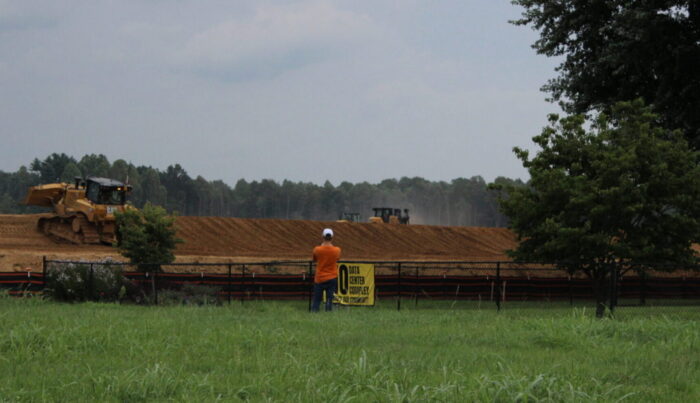
The Monarch site is still under construction but NScale, the development group in charge of Monarch, has said the site will begin operation with at least 1.3 gigawatts and could expand its capacity to up to 8 gigawatts. To meet the demand already contracted by two companies including Anthropic, creators of Claude AI, the Mason County site will have close to 900 methane gas generators.
“What they’re trying to do is get each area or each campus to be treated as its own minor source of pollution without taking into account, or just kind of closing your eyes and winking and saying, ‘Okay, if we have a bunch of those minor sources concentrated in one area, do they not add up to a major source?’” Di Bartolomeo said. “And so should they not be regulated differently?”
In October Gov. Patrick Morrisey announced a second high impact data center in Mason County, named Project Tamarack.
The Sierra Club warns that data centers’ independent power sources, sometimes referred to as “microgrids,” will increase local air pollution for the communities near the developments.
“For instance, the 864 on-site methane gas generators at Monarch, the project itself says that would produce over 600 tons of hazardous air pollutants, including nearly 300 tons of formaldehyde,” Di Bartolomeo said.
The report claims the proposed buildout of data centers is driving new investments in gas, diesel, and coal power plants and setting back critical climate benchmarks. Data center developers, and utilities that are gearing up to serve data center loads, have increasingly turned to new gas-fired power plants — and are even keeping aging coal plants online.
Di Bartolomeo calls the trend towards fossil fuels “a drive backward in the state of West Virginia that involves not looking at the reality of pollution, of health harms, of the unpopular reality of climate change in our state and continuing to sacrifice local communities for someone else’s profits.”
Earlier this week the Public Service Commission of West Virginia granted Monongahela Power Company and the Potomac Edison Company approval to move forward with construction of a 1,200-megawatt combined-cycle natural gas plant in Monongalia County. The approval included a surcharge of approximately $1.20 a month to ratepayers’ bills that are likely to increase in coming years.
A First Energy employee said that would only be the case if a data center didn’t make a catch-up payment. He said he would only expect that “worst-case scenario” if there were no data centers.
“Even if they’re not tied into AEP or whatever local utility it is, they’re still using power. And I think all of us understand from high school economics, supply and demand, right? The more demand there is, the less supply, the higher the expense,” Di Bartolomeo said. “If there are more people demanding more power, that has to come from somewhere. And obviously, Sierra Club’s position generally is more power demand should be coming from renewables and battery storage, which are the cheapest, most reliable, and most affordable options rather than fossil fuel generation.”
West Virginia has fast-tracked data center development with House Bill 2014. Passed in 2025, the law allows data centers to establish microgrids and prevents any local control like municipal zoning or noise ordinances.
Proponents say the law creates a single regulatory standard that provides developers a clear, predictable set of rules. But critics like Di Bartolomeo said it has emboldened poor practices and manners from data center developers. She points to a data center proposal in Boone County that was awarded state certification before the public ever became aware of its existence and only came to light after reporting by the Charleston Gazette-Mail.
“Any other industry would not even conceive of going about business that way. You want to work with the community,” Di Bartolomeo said. “These AI data center developers are not being good neighbors to the folks in the communities where they’re going in. They’re not consulting with local leaders. They’re not talking to the people who live right next door and who have to deal with this horrific noise and light and dust that happens almost 24-7.”
Di Bartolomeo and the Sierra Club urge the state government to work with local communities and grassroots organizations to stop harmful developments in communities across the state.
“Decisions on local data center development must be made with impacts on West Virginians’ health, safety, and natural spaces weighed first, not last,” she said.