


Your browser doesn't support audio playback.
President Donald Trump is again seeking to boost the struggling U.S. coal industry, announcing a plan Thursday to spend nearly $700 million to support coal-fired power plants and coal exports nationwide. It was not immediately clear exactly how much in total will be spent in West Virginia.
Trump said the administration will use authority under a Cold War-era national defense law to support 13 coal plants across the country and help build coal plants in Alaska and West Virginia — the first new U.S. coal plants since 2013.
The money is also expected to help restart a shuttered coal-fired power plant in Maryland and support construction of a long-delayed coal export terminal in Oakland, California.
Together, the announcements are expected to support or create more than 14,000 jobs in coal, construction, rail and maritime industries, a White House official said. Trump invoked the Defense Production Act, a 1950 law that grants presidents broad authority over national security-related industries and said his actions will allow coal plants to invest in upgrades that will extend their operational lives for decades.
The plan will “reinforce the reliability of our electric grid, which is really the biggest beneficiary,” Trump said at a White House event that also touched on renovations to the Reflecting Pool, the wars in Ukraine and Iran and a UFC cage being built at the White House.
“Coal’s a great business,” Trump said. “In terms of power, there’s really nothing like it.”
Reactions
Emmet Pepper, policy director from Energy Efficient West Virginia, responded to the announcement Thursday.
“It seems like the coal industry is addicted to other people’s money,” he said. “It keeps using its political power and campaign donations to get special treatment by the state legislature, including tens of millions in state loans and hundreds of millions in higher electric bills for families and small businesses that pay for their power plants. Now they get $700 million from U.S. taxpayers.”
Gov. Patrick Morrisey stood beside Trump as he signed the executive order.
“This historic announcement is a massive win for West Virginia and our national security,” Morrisey said. “By protecting existing plants, building new facilities, and saving Americans $50 billion in electricity costs, President Trump is securing a reliable grid to power modern technology. West Virginia stands ready to lead this energy resurgence, lower costs for working families, and prove that clean, dependable coal is here to stay.”
Chelsea Barnes, the director of Government Affairs and Strategy for the advocacy group Appalachian Voices, noted that recent requests to the federal government for support for clean drinking water in southern West Virginia have been denied.
“The Trump-Vance Administration is now pouring hundreds of millions of dollars in taxpayer money to prop up aging, expensive, and unreliable coal plants — and even building new coal plants despite cheaper, cleaner options,” Barnes said. “This will add to already skyrocketing electricity bills and add to pollution and public health problems caused by both the mining and burning of coal, at a time when West Virginians are being denied funding for access to basic necessities like clean water.”
A statement from the Energy Department (DOE) said the four projects selected under DOE’s “Restoring Reliability: Coal Recommissioning and Modernization” initiative will receive up to $350 million to expand and reinvigorate America’s coal fleet through targeted upgrades that increase efficiency, extend plant life, and add dependable capacity.
Combined, these projects could add or preserve approximately 3,565 megawatts (MW) of coal-fired generation capacity — enough electricity to serve roughly three million U.S. households each year:
Two projects in Anchorage, Alaska, and Mt. Storm, West Virginia in Grant County, are planning new coal-fired power plants with a combined capacity of 2,850 MW.
Dominion Energy currently operates a coal-fired power station and the Mount Storm Wind Farm at Mt. Storm. The coal-fired plant has been in operation for 60 years. The wind farm has been undergoing a massive repowering project to modernize turbines and boost generation.
It was not immediately clear how much federal money would be used in the Mt. Storm project.

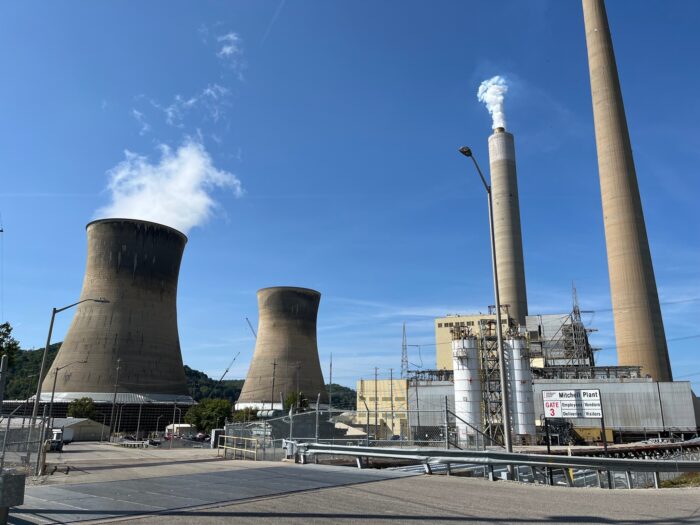
Photo Credit: Curtis Tate/West Virginia Public Broadcasting
Additionally, an overview of the projects includes $51 million for the Mitchell Mechanical Draft Cooling Tower Modernization Project. Wheeling Power Company in Moundsville plans to modernize the Mitchell Plant. This upgrade will enhance regional grid reliability, reduce outage risk, and improve overall system efficiency, contributing to regional energy affordability.
The total cost of the project is estimated at $158,600,000.
A separate release from the Energy Department noted that up to $75 million will be used for the West Gateway Terminal Project, a rail-served marine export terminal capable of handling more than 10 million tons of bulk commodities annually. The West Gateway project in Oakland, California, will expand West Coast export capacity and support energy exports to allied nations including Japan, South Korea, Taiwan, Vietnam, and Malaysia. It is unclear if any West Virginia coal would be shipped that way. Most of West Virginia’s coal heads east to the Port of Baltimore.
In February, the Energy Department announced $175 million in funding for six projects to modernize, retrofit, and extend the useful life of coal-fired power plants that serve rural and remote communities across the United States.
Selected projects include the following:
- Appalachian Power Company (Letart and Winfield, West Virginia) will upgrade two coal-fired plants in West Virginia: the Mountaineer Power Plant in Letart and the John E. Amos Power Plant in Winfield.
- Buckeye Power Inc. (Brilliant, Ohio) will perform a comprehensive suite of upgrades targeting critical systems at its Cardinal Plant coal-fired Units 1 and 2.
- Duke Energy Carolinas LLC (Sauratown Township, North Carolina) will upgrade two coal-fired units at the Belews Creek Steam Station.
- Kentucky Utilities Corporation (Ghent, Kentucky) will increase the annual capacity factor of Unit 2 of the coal-fired Ghent Generating Station.
- Monongahela Power Company (Maidsville, West Virginia) will upgrade the Fort Martin Power Station, which consists of two coal-fired generating units.
- Ohio Valley Electric Corporation (Cheshire, Ohio) will upgrade all five coal-fired generating units at the Kyger Creek Station.
Trump Seeks To Reverse Long-Term Decline In US Coal
The announcement is the latest step by Trump to try to reverse the years-long decline in the U.S. coal industry. The administration said last fall it would open 13 million acres of federal lands for coal mining and provide $625 million to recommission or modernize coal-fired power plants. Trump issued executive orders soon after retaking office to try to revive coal, a reliable but polluting energy source that’s long been shrinking amid environmental regulations and competition from cheaper natural gas and renewable energy.
Under Trump’s orders, the Energy Department has required coal-fired power plants in Michigan, Indiana, Colorado and Washington state to keep operating past their retirement dates to meet rising U.S. power demand amid growth in data centers, artificial intelligence (AI) and electric cars. The Energy Department has extended short-term orders to allow those efforts to continue and has ordered oil and gas-fired plants in Maryland and Pennsylvania to run past scheduled retirement dates.
Energy Secretary Chris Wright issued an emergency order Thursday requiring a coal-fired power plant in Orlando, Florida, to remain open past a planned shutdown this month.
Wright repeated a claim Thursday that the administration’s use of emergency orders to keep aging coal-fired plants operating helped prevent major blackouts during brutally frigid weather that gripped most of the country in late January and early February.
The Environmental Protection Agency (EPA), meanwhile, proposed revisions to an Obama-era rule on regional haze that EPA Administrator Lee Zeldin said would have forced the closure of a coal-fired power plant in Wyoming. The plant uses Wyoming coal, supports hundreds of Wyoming mining and energy jobs and is essential to delivering reliable, affordable energy to families across the state, Zeldin said.
Interior Secretary Doug Burgum, the third Cabinet member at the White House event, called coal crucial to the U.S. electric grid. “It’s the backbone of having affordable, reliable and secure American energy to power our country, power our electric grid, power our competitiveness in AI and power all the manufacturing that’s coming back,” he said.
Activists Call Trump’s Priorities Archaic
Environmental groups denounced the latest efforts to boost coal, which come as the Trump administration has clamped down on renewable energy, including freezing permits for offshore wind projects, ending clean energy tax credits and blocking wind and solar projects on federal lands.
“Propping up coal billionaires with taxpayer money is one more way for the Trump administration to put polluters first and put the rest of us at risk,” said Kit Kennedy, managing director for power at the Natural Resources Defense Council. “What’s next, a taxpayer bailout to build new phone booths?”
Kennedy and other critics say Trump’s order will result in higher electricity bills and dirtier air. “The best thing for the air, the climate and our utility bills is to let these plants retire peacefully,” she said.
“Spending $700 million to bail out the coal industry is like throwing a lifeline to a ship that has already sunk,” said Lena Moffitt, executive director of Evergreen Action, another environmental group.
Rich Nolan, president and CEO of the National Mining Association, said coal generation helps shield consumers from the impacts of volatile energy prices and supply challenges exacerbated by AI.
Trump’s strategy will “ensure that upgrades to existing energy assets are made” domestically, “and at our ports to ensure that U.S. coal can answer the world’s needs,” he said.
Coal once provided more than half of U.S. electricity production, but its share dropped to about 15% in 2024, down from about 45% as recently as 2010. Natural gas provides about 43% of U.S. electricity, with the remainder from nuclear energy and renewables such as wind, solar and hydropower.
Coal Exports Have Dropped
U.S. coal exports dropped during the first year of Trump’s second term, largely due to less coal being shipped to China after it imposed reciprocal tariffs on American products last year in response to broad tariffs announced by Trump, according to the Energy Information Administration. Global coal demand rose to record levels in recent years but is expected to flatten or decline in the coming years, according to the International Energy Agency.
It’s hard for U.S. companies to expand into new markets because there are plentiful reserves of coal around the globe.
Even so, Trump has pushed to revive coal exports on the West Coast. Coal miners have long sought to ship coal from Utah and the Powder River Basin in Montana and Wyoming to markets in Asia.
Developers are fighting the city of Oakland to build an export terminal on the site of a decommissioned Army base. Community members and advocacy groups have voiced concerns over how trains loaded with coal will affect public health, safety and the environment.