


Your browser doesn't support audio playback.
The sound of gunfire ruptured the cool morning air at the edge of West Virginia’s Kanawha State Forest near Charleston as shooters practiced with their weapons at the gun range.
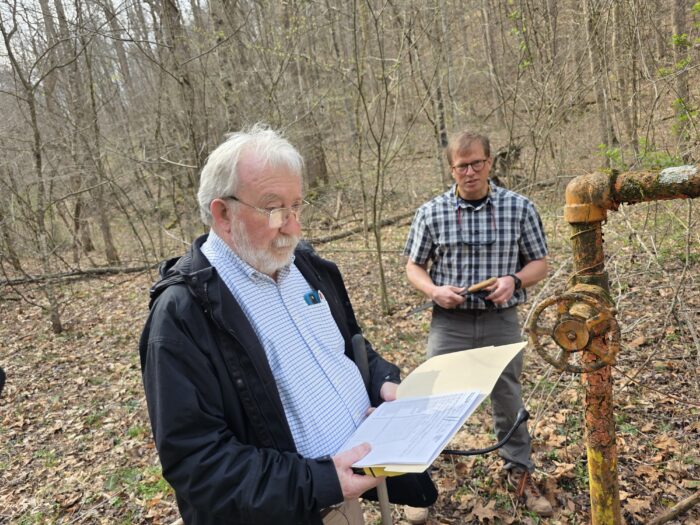
Ted Boettner, senior researcher at the Ohio River Valley Institute, and Dave McMahon, the co-founder of the West Virginia Surface Owners Rights organization, were going to take a look at an abandoned natural gas well.
After about a 10-minute hike, they came upon a rusted-out brine tank used to store salty water that rises from the wells. Another few minutes and McMahon stood beside an abandoned well. The rotten eggs odor of hydrogen sulfide leaking from the well casing was strong.
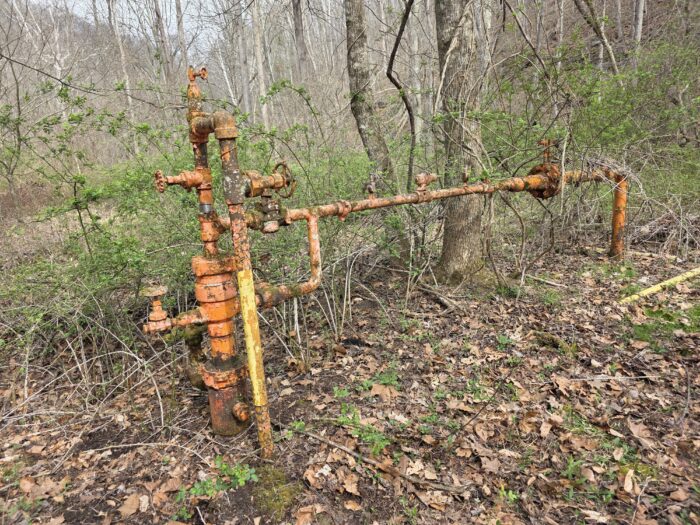
Photo Credit: Eric Douglas/West Virginia Public Broadcasting
McMahon read the statistics from the well’s production record.
“It was originally drilled in 1943 by United Fuel Gas, the predecessor to Columbia,” he said. “They drilled it to 4,500 feet. And they produced gas for a while. Then they came back in 1965 and drilled it deeper.”
This particular well is abandoned but not orphaned. There is a difference.
“The statute calls an abandoned well when it hasn’t produced [gas] in 12 months,” he said. “But sometimes they’re not really abandoned. They still have a responsible operator. If the responsible operator disappears, then you’ve got an orphaned well.”
The Kanawha State Forest well is owned by Pillar Energy LLC. A company representative confirmed by email that it has applied to the West Virginia Department of Environmental Protection (WVDEP) for a permit to plug the well.
Abandoned Wells
Boettner recently produced a report on orphaned and abandoned wells in the state called West Virginia’s Abandoned Well Problems for the Ohio River Valley Institute.
“It was quite fascinating to learn that we’ve been requiring companies to plug wells since 1891 or 1892, I believe,” he said. “But the requirement was ‘well-seasoned wood plugs,’ and there was no state office to really enforce any of it.”
Permitting for gas wells began in 1929, but the first gas well was drilled in 1860 in what was then Virginia, according to Boettner. The West Virginia DEP declined to make anyone available for an interview for this story, but in an emailed statement said there are approximately 6,300 documented abandoned and orphaned wells statewide.
“We know from a previous study the DEP did in the 1990s, that the estimated number of abandoned wells, mostly wells drilled before 1929, is over 50,000,” Boettner said.
Gas wells are located throughout the state, with higher concentrations in areas such as the Northern Panhandle and along the Ohio River Valley due to historic oil and gas development.
Plugging Natural Gas Wells
The average cost to plug an orphaned well in West Virginia is approximately $65,000, according to the DEP. Actual costs can vary significantly depending on site-specific factors such as well condition, terrain, accessibility and proximity to structures.
Using the DEP’s numbers, it would cost more than $400 million to plug the documented orphaned wells in the state.
In 2020, the West Virginia Legislature established the Oil and Gas Abandoned Well Plugging Fund, which now directs several million dollars from severance taxes annually toward plugging efforts. As a result, the number of wells plugged with state funds has increased from one well in 2021 to 94 wells in 2025. The DEP estimates 150 wells will be plugged using state and federal funds in 2026.
Twenty minutes away in the town of Dunbar is an orphaned well. It’s leaking while it sits within yards of a road that runs parallel to the interstate.
McMahon poured some water on the wellhead, and it immediately began bubbling up with leaking methane and hydrogen sulfide.

There’s no protective barrier around it. If a vehicle failed to make a turn onto the road in front of it, it could be disastrous. It stands beside a town water pumping station that is fenced off.
This well was drilled in 1929 and there’s no viable company in charge of it. It will be up to the state or the federal government to plug this one.
Air Quality And Pollution
Kevin Stewart, director of Environmental Health at the American Lung Association, discussed the 27th annual “State of the Air” report with West Virginia Public Broadcasting recently. He was asked about hydrogen sulfide and methane in the atmosphere.
“It’s an air toxic. You don’t want to be breathing hydrogen sulfide, and certainly methane is something that the Lung Association recognizes is a very powerful agent that exacerbates climate change,” Stewart said. “It’s more powerful than carbon dioxide, and it’s something that is certainly emitted by natural gas operations, including the abandoned well sector.”
According to the Union of Concerned Scientists, methane is 34 times stronger than carbon dioxide at trapping heat over a 100-year period and 86 times stronger over 20 years.
Stewart said he is worried about these emissions because the changing climate is allowing more pollutants and lung irritants to build up.
“We’ve seen some of that already in some of the data,” Stewart said. “Ozone levels are a lot higher than we’d expect them to be from the same amount of emissions that we’re creating, because of things like higher temperatures and bright sunlight and slow air movement, where the more stagnant air allows the pollutants to build up. Those are the consequences of a changing climate.”
The Environmental Protection Agency (EPA) estimates that in 2021, methane emissions from natural gas and petroleum systems and abandoned oil and natural gas wells were the source of about 33% of total U.S. methane emissions, and about 4% of total greenhouse gas emissions.
“I think it’s important to recognize oil and gas form a basis for our modern public life, too,” Boettner said. “They’re in plastics, fertilizer and they generate 40% of our electricity production in the country. This is something obviously we need as a society. But at the same time, it’s really important that companies that agreed to plug their wells do that.”