


Your browser doesn't support audio playback.
The drive to the Red Oak Fire Lookout tower in Webster County, in the Monongahela National Forest, is up a well-maintained gravel road through a canopy of trees that makes it feel like you’re motoring through a tunnel.
It’s even more jarring when you arrive at a clearing at the top of the hill and see a tower standing 80 feet straight up to your right.
“So we’re at the Red Oak Fire Tower area,” Matt Edwards, the South Zone Recreation manager for the Monongahela National Forest, said. “This served as a fire lookout from the 1930s till around the 1970s, early 80s. Fire detection was mainly done through these lookout sites.”
The Red Oak Fire Tower was decommissioned when the search for forest fires turned to planes, helicopters and technology. It didn’t require fire wardens to live on site for weeks at a time constantly scanning the area.

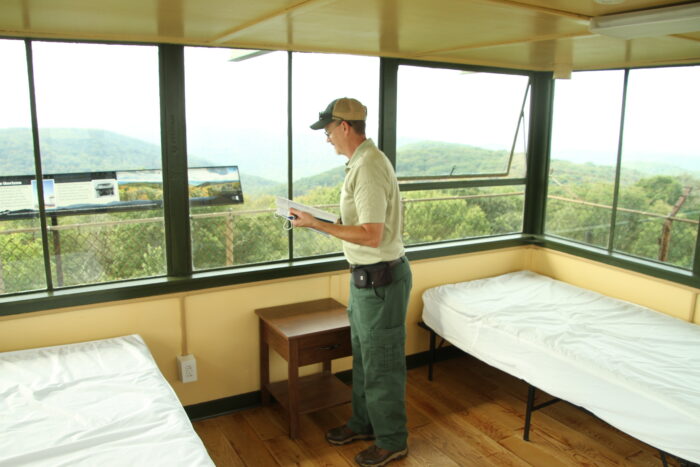
Photo by Eric Douglas/West Virginia Public Broadcasting
But now, it’s the latest camping spot for the hearty. If you can wait.
“It opened on Aug. 28 to reservations and within four days all the reservations were booked from August, late August the whole way through the end of November,” Edwards said.
Steel stairs lead to the top of the tower where there’s a 14-foot square cabin with panoramic windows and a metal catwalk. There’s electricity, but no water. And two twin beds. The toilet is on the ground.
But the camp site is set up with spaces for a larger party to stay and visit the cabin while still sleeping on the ground level in tents or in a camper.
Which makes for a much different experience than the fire wardens had.
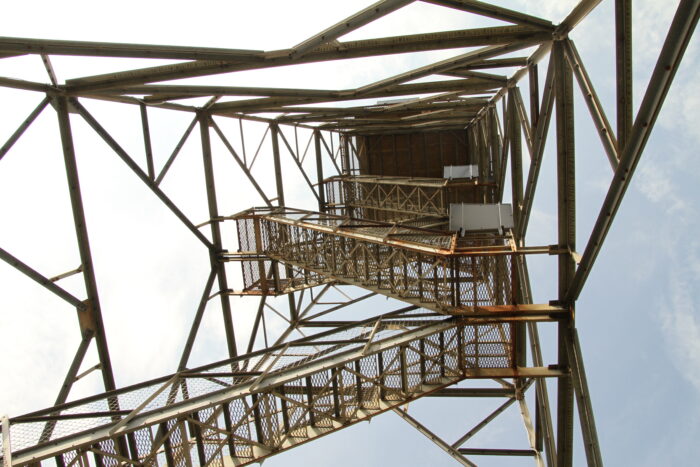
Photo by Eric Douglas/West Virginia Public Broadcasting
“The connotation with being a fire lookout is that it was an extremely isolated job,” Paden Vargo, an architectural historian for the Monongahela National Forest, said. “One person in a fire tower in a very remote area. But really the purpose of a fire lookout was to be the first eyes and sort of the first line of defense in fire control.”
Weather monitoring was an important part of the fire warden’s job.
“They would take measurements on relative humidity and direction of wind. If there were any storms forming, they would make notes of that,” Vargo said. “And then throughout the day, they would do watches in all directions.”
Especially in the remote forest, most of the forest fires were started by lightning strikes.
Access to fire towers like Red Oak was difficult, but not impossible. In some cases, families could visit and bring food. Still the wardens had a job to do and they didn’t leave for at least two weeks at a time, or longer if necessary.
“I would say it was a lot of monotony punctuated by incredible intense action with lightning storms, spotting fires, and then getting everyone to engage in that,” Vargo said.

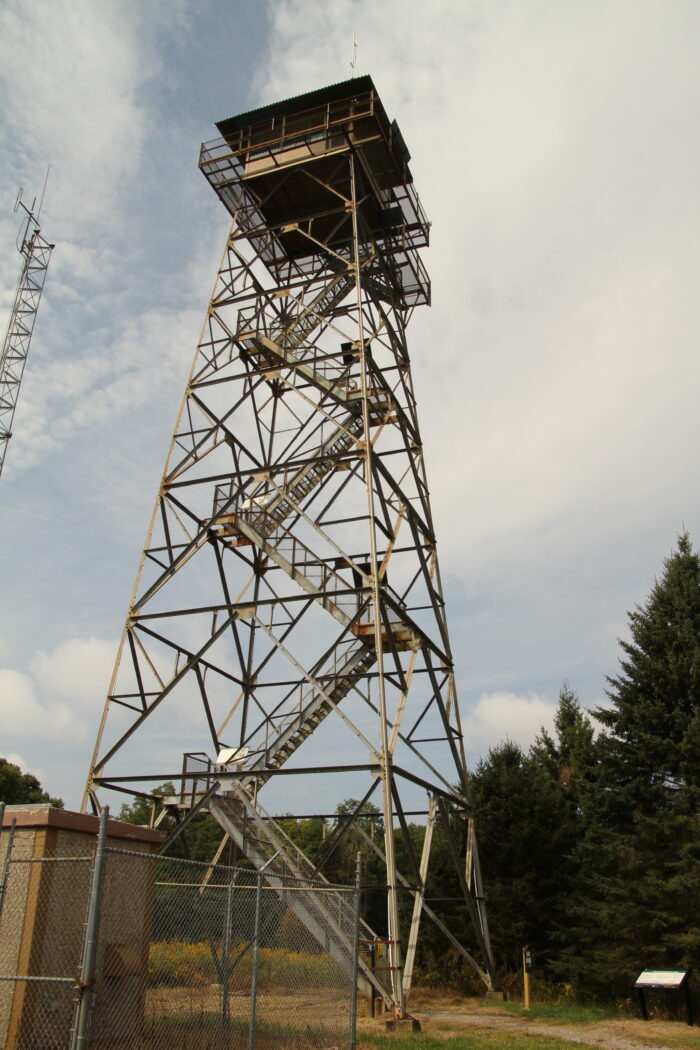
Photo by Eric Douglas/West Virginia Public Broadcasting
The Red Oak Fire Tower was originally built in 1934 by the Civilian Conservation Corps. But it was shorter. The forest had been largely stripped of tress by logging, so height wasn’t a priority. Fires mostly occurred in bushes, scrub and debris left behind. In 1964, the wooden structure was replaced with a taller steel tower as the trees grew.
When they spotted a fire, the next step was getting the word out.
“Communication was primarily telephone-based,” Vargo said. “They would run telephone lines up to the fire towers, and those telephone lines were connected to other fire towers to allow other lookouts to triangulate the smoke or the fire that they might have seen. But then lines also ran into what we called district offices, ranger stations essentially.”
Vargo said he did a lot of work on the restoration of the tower personally and says it is an amazing experience to stay in it.
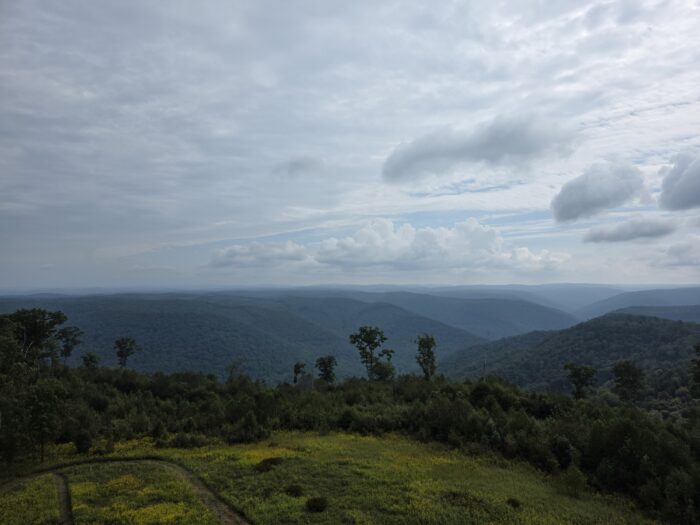
“Just being able to be above the tree line and see a part of the Monongahela National Forest that a lot of folks haven’t had the privilege of seeing yet was really phenomenal,” he said. “Seeing the sunset was awesome. And then I was actually up there during a storm, and that was eye-opening and sort of gave me a perfect lens into what it would have been like for a fire lookout.”
For those interested in camping above the forest, there are no spots left this fall. Beginning January 1, visitors can go to the recreation.gov website and book a spot. They aren’t open during the winter months because the roads aren’t maintained. The full season runs April 15 until the end of November.
Renters can stay there for one night or as long as two weeks at a time.