


Your browser doesn't support audio playback.
National Save A Life Day – organized by the harm reduction non-profit SOAR WV, based in Charleston – is on tap for later this month.
But there’s a perceived stigma that sometimes makes people who’d like to help reluctant to pick up the free naloxone kits that are given out.
Maria Young caught up with Caroline Wilson, the National Save A Life Day coordinator, to find out what to expect if you stop by one of the hundreds of booths planned across the state.
The following has been edited for clarity and length.
Young: Let’s start with when is Save A Life Day and more importantly, what exactly is Save A Life Day?
Wilson: Save A Life Day this year is going to be on Sept. 24. It’s a Thursday and it’s annual Free Naloxone Day. So it’s something that we started in West Virginia back in 2020 and it has grown to become fully nationwide. And so on Save A Life Day, organizations across the country put on free naloxone events and they hand out naloxone and they provide education to people about how to reverse opioid overdoses.
Young: And so this started in West Virginia, which I think a lot of us consider to be kind of the epicenter of the addiction crisis. Is it more prominent in West Virginia than it is in other states?
Wilson: Yes, because we started it in West Virginia, the first, like, three years were spent building up events across every single county in West Virginia. So we do have a really high rate of participation here. Every single county participates. Last year, West Virginia gave out over 30,000 doses of naloxone. In our total across the nation was like 133,000. So that’s a pretty big chunk in West Virginia.
Young: Tell me what happens on this day.
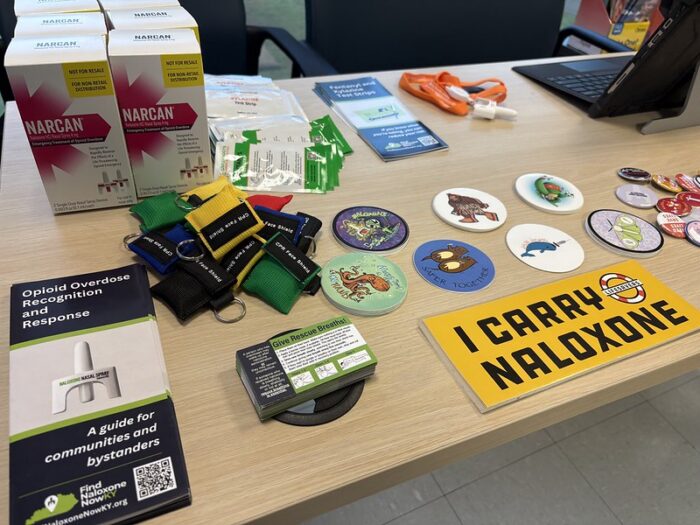
Wilson: A lot of organizers will put together a lot of different types of events, but a lot of them are pop-up events. So you might set up outside of maybe a dollar store, a church, a hospital, a bus stop, anywhere that’s kind of a high traffic area and try to talk to everyone that you see about naloxone. And every person that comes up to your table and is interested does get trained. We train everybody on how to use it. And that takes really maybe five minutes.
A lot of events will also give out various resources. So resources for recovery, for treatment, for harm reduction programs. Some events will give out additional supplies. Maybe they have food, maybe they have wound care kits, anti-stigma swag. We give out a lot of anti-stigma swag at these events. A lot of places also do mobile outreach teams. And so the mobile outreach teams will go to businesses, to hotels, to encampments, to downtown areas and hand out naloxone that way.

Courtesy of Caroline Wilson/National Save A Life Day
Young: When you say anti-stigma items, I guess you’re referring to the idea that a lot of folks feel like there’s a stigma for those who are in addiction. Is that what you mean?
Wilson: So there’s a certain stigma actually around just having naloxone. So as many years as I’ve been doing this, you’ll always have a percentage of people that when you offer them naloxone, they’ll say, “I don’t need that.” Like, “I don’t do drugs,” right? And so we have to break through that stigma of like, it’s not for you, you know?
And it’s more so like the idea that you care about other people. And if you came across someone that was dying in front of you, that you would save them because you had this tool with you, you know? And so there’s kind of a stigma around even having it with you because some people think maybe that makes them look like they hang out with people that do drugs or they do drugs themselves.
Young: What is the hope of a day like this?
Wilson: The overall goal is #1 to save lives and #2 to change hearts and minds of the people that we encounter throughout the day. But the goal, at least on behalf of the SOAR team, is not recovery. I mean, that would be great for people if that’s something that they want and that they’re ready for. And we have had a number of organizers report back that they’ve had people come to their events and send them to detox that same day, and that’s awesome.
But that’s not really our goal because we do believe that every life is worth saving, regardless of what they choose to do afterwards. Because we don’t just save people because we want them to be in recovery, we save them just because they’re human beings.
Young: Sure, but you also might save them and want good things for them, right?
Wilson: We do want good things for them, but it’s more like self-determination and autonomy. So recognizing that even if we have to save them 20 or 30 times, people will only go to treatment and get into recovery like when they’re ready to do that. And so it’s more about harm reduction and less about recovery.
National Save A Life Day is planned for Sept. 24. Click here for an interactive map of scheduled Save A Live Days events.