


Your browser doesn't support audio playback.
This story is part of the Appalachia + Mid-South Newsroom‘s series, When Data Centers Come To Town.
Data center development is a fast growing industry, with projects popping up in seemingly every corner of the country. But that’s not been the case in West Virginia so far. Now, state officials are rolling out the red carpet for the expensive and increasingly expansive projects.
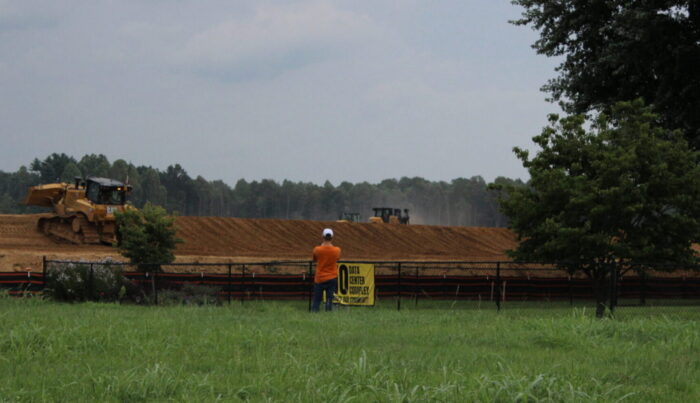
West Virginia is largely untouched by data centers today. When completed, the 1.3 gigawatt Monarch Compute Campus currently breaking ground on the banks of the Ohio River north of Point Pleasant will become the state’s first and likely the largest on Earth.
For the past four months, Randy and Marsha Frame have lived with the daily noise of the construction of the 2,000-acre project as their neighbor. In May, stormwater runoff from the site flooded their yard. The neighborhood has been flooded twice, prompting state intervention.
They said heavy machinery completing earthworks for the site — and now completing a berm intended to prevent future flooding — has shaken their house enough to damage their foundation.
“This was the death of our dream, and we didn’t want much other than to be left alone,” Marsha said. “It’s been a death of the neighborhood.”
The Frames want to stay. But even before the first building is erected, 60% of homeowners in their neighborhood have already agreed to sell to the developers.
“We pretty much built a family here. It’s like losing a family member every day,” Randy said.
The development group in charge of the Monarch Compute Campus have said the site could expand its capacity to up to 8 gigawatts. Just across the river the General James M. Gavin Power Plant, the largest coal-fired power plant in Ohio, produces 2.6 gigawatts, enough to power an estimated two million homes.


Photo Credit: Chris Schulz/West Virginia Public Broadcasting
West Virginia Law Strips Local Regulating Powers
Up the road from the Frames, Kevin Queen has tried to mount community resistance against the development. He said locals were railroaded into the development with no real voice in the process.
“They’ve cited statistics of how many hundreds of millions of dollars is going to pour into the county over the next number of years. Those numbers they say, they got from the tech companies, from the data center companies,” Queen said. “They didn’t crunch the numbers themselves, and that, I believe, is why they decided to go along, because they looked at what they looked at. It was the money, it was the financial gain, and I believe that the politicians were deceived.”
Across West Virginia, at least five large-scale data centers are in various stages of development.
Amy Margolies is the executive director of Tucker United, a grassroots coalition that formed after a data center with its own natural gas power source — known as a microgrid — was announced to be in development within a mile of her son’s school.
“It’s not that data centers haven’t existed,” she said about pushing back against development. “There have not been a lot of these facilities executed at this scale, and none yet in the state of West Virginia. So we actually don’t know what the economic impacts of this are going to be.”
Margolies said basic questions about the project’s public effects remain unanswered. The gas-powered microgrid proposed near her home is expected to generate 750 megawatts of power, double the output of most natural gas power stations in the state.
Tucker United, along with other citizen groups including the Sierra Club and West Virginia Highlands Conservancy concerned about the environmental impact of Fundamental Data’s Ridgeline Facility in Tucker County, have appealed to state regulators and even the courts for more information.
“We’re just trying to understand what is the scope of this project, and how could it affect our water? How could it affect our land? How could it affect my children?” Margolies said.
West Virginia is trying to catch up to its neighbors with House Bill 2014. Passed in 2025, the law allows data centers to establish microgrids and prevents any local control like municipal zoning or noise ordinances.
Proponents say the law creates a single regulatory standard that provides developers a clear, predictable set of rules — something Chris Morris, director of West Virginia’s Data Economy Office, argued will help the state remain competitive on a national scale.
In an email, Morris also referenced the law’s creation of a Data Center Liaison to review applications and address concerns of local stakeholders.
Margolies and others remain unconvinced.
“We’re not saying, you know, we’re anti-data centers,” she said. “We’re saying, ‘Look, for us in Tucker County, this is a local issue.’ We feel like this project in this location, in this process, is not right for us.”
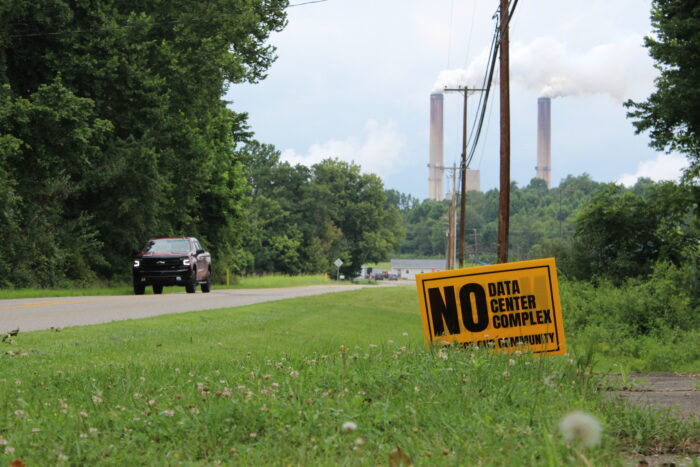
Photo Credit: Chris Schulz/West Virginia Public Broadcasting
An Uncertain Future
Tucker County and much of West Virginia have spent decades leveraging natural beauty to transform into a tourist destination. Margolies is concerned that if the landscape is permanently altered by the data center industry, there is no getting it back.
“We’re pro-economic growth for Tucker County, but we want that to be smart and strategic growth, because we need to build on the economy that we have,” she said.
Analysts like Kelly Allen, executive director of the nonprofit West Virginia Center on Budget and Policy, said it’s been difficult to analyze the proposed benefits of data centers because it’s unclear what the actual scale will be.
“When we see ribbon cuttings or economic development announcements, those eye-popping numbers are usually based on maximum build-out scenarios that are often done in phases. They can often take years or even decades, if they come to fruition at all,” Allen said. “So it is kind of like a coin flip if this thing is really going to happen, and then it’s even more of a long shot if we’re going to see the maximum build-out scenarios that are being promised.”
To add to the uncertainty, West Virginia has provided ample tax breaks to data center developers, significantly reducing the primary benefit for a community landing a project.
According to HB 2014, 70% of all tax revenue is diverted to the state’s coffers, leaving 30% for local governments to distribute as they see fit. Allen said the law’s removal of local control and consolidation of regulation at the state level has become a selling point to developers.
“There’s a real imperative for policymakers to really think about, I think, the bending over backwards they’re doing to attract these developers and what they’re willing to give away of our communities,” she said. “Whether that’s their voices, whether that’s the tax revenue that helps decide the classroom size or if your local school stays open, or the quality of the water, our electricity rates.”
Although Democrats make up less than 10% of the state legislature, party Chair Mike Pushkin said they have vowed to make reinstating local control of development a priority in the upcoming legislative session.
“If we’re going to do this, we should do it like other states do it and do it right, and allow for the people to have a say so in who’s putting the data center in their backyard,” he said.
Members of West Virginia’s Republican supermajority have also indicated interest in reforming the law. Until then, the state’s centralized data center development will continue.

Photo Credit: Chris Schulz/West Virginia Public Broadcasting
This story is part of our series exploring the impacts of data centers in our region. It was produced by the Appalachia + Mid-South Newsroom, a collaboration between West Virginia Public Broadcasting, WPLN and WUOT in Tennessee, LPM, WEKU, WKMS and WKU Public Radio in Kentucky, and NPR. Sign up for the weekly Porch Light newsletter here for news from around the region.