


Your browser doesn't support audio playback.
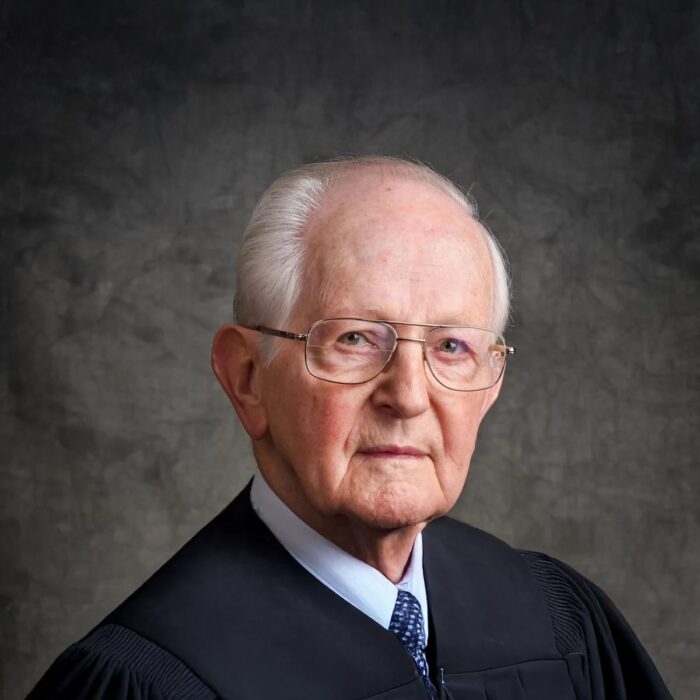
In a statement released by Chief United States District Judge Frank W. Volk, he announced the passing of Judge John T. Copenhaver, Jr., at 100 years of age.
He said Copenhaver was a cornerstone of the federal judiciary in West Virginia for over six decades.
“Since beginning his service in 1958, he has served this court and the citizens of this state with unparalleled wisdom, integrity, and a profound dedication to the rule of law,” Volk said. “His impact on the Southern District of West Virginia and the judiciary is truly immeasurable.”
Copenhaver served continuously on the federal bench from his appointment as referee in bankruptcy by Judge Benjamin F. Moore in 1958 until his death — a span of more than 68 years, more than any other federal judge in United States history.
“I believe Judge Goodwin, a longtime judge of this Court, said it best: ‘I never saw another judge command a courtroom more completely — yet he never had to raise his voice. Judge John Copenhaver was a wonderful friend and a brilliant, singularly respected federal judge. After trying many cases before him and serving with him as a colleague for over 30 years, I respected him so deeply that I never called him by his first name. Like everyone who knew him, I simply called him ‘Judge.’ Even after turning 100 last September, his memory, acuity, and devotion to his work never diminished. Through his work, his teaching, and his example, he advanced and preserved the rule of law and the ideals that sustain our system of justice.’”
Copenhaver was born in Charleston on Sept. 29, 1925. He was educated in the Charleston schools and afterward at the Kentucky Military Institute, from which he graduated in 1942 at the age of sixteen. Like many of his generation, he entered the service before he entered adulthood. He was assigned to the Americal Division of the United States Army and shipped first to New Caledonia and thereafter to the Philippines and then Japan. He rose to the rank of sergeant. He served in the field as a medic, attending to the wounded in the Pacific.
He was honorably discharged in 1946 and returned to West Virginia. Upon his return to the United States, he entered West Virginia University in Morgantown, where he earned a degree in 1947.
He went from college directly to the West Virginia University College of Law, earning his degree there in 1950.
After graduation Copenhaver served as a law clerk to United States District Judge Benjamin Franklin Moore in Charleston. In 1958, Moore appointed Copenhaver to the office of referee in bankruptcy for the Southern District. His expertise grew and eventually he assisted in the brokering of a consensus that led directly to the Bankruptcy Reform Act of 1978. He was also profiled in People magazine.
Copenhaver was appointed to the federal bench by President Gerald Ford. He was confirmed by the U.S. Senate on Sept. 1, 1976.
Copenhaver was an active status judge until his death on May 12. He turned 100 in September of 2025 and was the longest serving federal judge in United States history. He was also the last Ford appointee on the bench. Over thirty years of published opinions, the reversal rate of his decisions hovered around 2%, a figure all the more remarkable for the difficulty of the cases that came before him. The reviewing courts found it sufficient on more than one occasion to affirm upon his reasoning.
As the late Judge Donald Russell of the Fourth Circuit put the matter, “We cannot say it any better than he did.”
In the litigation arising from the Buffalo Creek Flood disaster, he held that unborn children could pursue claims for injuries sustained in utero, a humane extension of existing tort principles that respected both medical science and moral intuition.
In the litigation arising from a failed trade school, he held that the consumer-protection law of West Virginia could coexist with the federal student-loan statutes, and that students defrauded by the school could accordingly assert their defenses against the lenders.
He assumed senior status on Nov. 1, 2018, but continued to carry a full caseload. In 2023 he filed a memorandum opinion of 416 pages, the longest, it is believed, ever entered in his district.