


Your browser doesn't support audio playback.
West Virginia lawmakers from both parties raised concerns about AI-enabled surveillance camera systems during Sunday’s legislative interim meeting of the Joint Standing Committee on Government Organization.
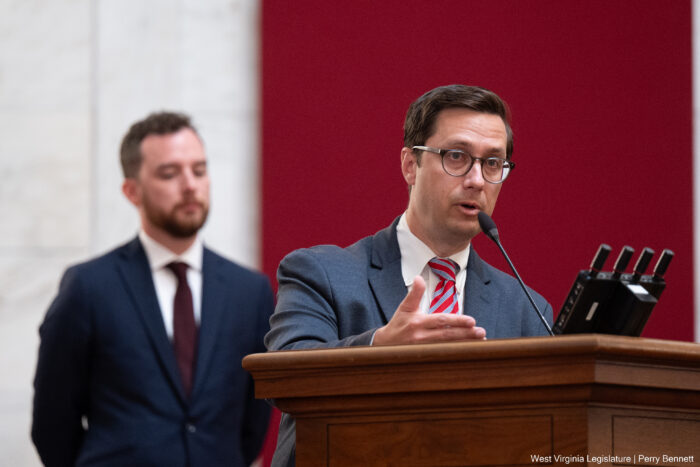
Alasdair Whitney, legislative counsel for the law firm Institute for Justice, and Kevin Kane, director of Government Affairs for Flock Safety, a major manufacturer of the camera systems that have been the focus of controversy lately, each offered presentations to the group.
Whitney began by offering a series of examples of cases his firm is involved in.
“The numbers in our San Jose case are even more sobering still,” he said. “They show where this technology might be heading.”
Whitney said the city of San Jose had four Automated License Plate Reader cameras in 2021. Today it has 474.
“They sit on residential streets on the same block as an immigration attorney’s offices and around hospitals, hospice facilities and places of worship,” Whitney said. “Those cameras took more than 360 million photographs of vehicles in 2024.”
One quarter of 1% of those photographs were on a hot list alert or otherwise connected to a vehicle suspected of criminal wrongdoing. Everything else were people going about their daily lives, their daily business, ordinarily living, he said. He also explained that 1,000 city employees have access to that data and it is shared with nearly 300 other Flock customers. San Jose’s data was searched nearly 2.5 million times or 15,000 searches a day.
In recent weeks, the city of Huntington approved a contract with Flock Group to install the camera systems in the city. That was after a 10-hour city council meeting where all but one speaker was opposed to the contract. Since then, the city has been sued to stop the contract and a group of citizens is organizing a petition that calls for a special election to ban the camera in the city.
Whitney closed his presentation asking for legislation to regulate the surveillance systems.
“These systems do not show a day in the life,” he said. “They show a way of life. They deserve and need to be regulated before these things are expanding on every street corner or in every road that we drive on. We urge the committee to err on the side of the Constitution and to protect West Virginians from warrantless mass surveillance before that actually happens.”
Many constitutional law experts question if the system violates the Fourth Amendment to the Constitution that protects Americans from illegal searches.
Whitney cited several court cases that indicate the judiciary’s support for 4th amendment protections against digital surveillance. Most notably, he repeatedly pointed to June’s ruling Chatrie v. United States in which the Supreme Court upheld that law enforcement needs to get a warrant in order to use certain digital, location-based surveillance tools. He suggested to the committee that regulations on ALPR-style surveillance systems should include requiring a warrant to access databases like Flock’s.
Monday morning, Del. Evan Hansen, D-Monongalia, announced he was already working on such a regulatory bill.

Flock Questioned Directly
After the two presentations, nearly a dozen lawmakers asked questions with many of them directed toward Kane from Flock Safety.
Del. Tristan Leavitt, R-Kanawha, asked Kane about the ability to hack Flock cameras. Kane explained that there are some videos on YouTube that purport to have hacked Flock.
“At no point in time did those videos or that individual ever gain access to Flock’s database,” Kane said.
But when Leavitt asked if they did gain access to video footage, Kane said they did.
“Due to a bug, for a very limited number of cameras for a very brief period of time,” Kane said. He went on to say that he wasn’t aware of any other breaches.
“In December, the digital news outlet 404 reported that 60 of your cameras in Bakersfield, California, were able to be accessed,” Leavitt said. Kane said he was not familiar with that incident.
Kane explained that the company recently “beefed up our team, including hiring a new chief security officer and expanded his team to ensure that we are investigating and taking all appropriate action to keep your constituents’ data safe.”
Shifting gears, Leavitt asked about Flock cameras and whether they offer facial recognition.
“We do have a live video camera that we provide as well that would provide, if an individual were to walk past a camera, that could provide a notification, but nothing on that would do anything to provide any type of facial recognition technology,” Kane said.
The databases generated by license plate readers and other variations of the AI-assisted cameras have shareable databases that are available for nationwide search.
Del. Kayla Young, D-Kanawha, asked what would happen in those searches if a state banned a specific use for a camera system, but then a neighboring state accessed that state’s data.
“You have to have a specific search reason based off of NIBRS codes for communities that have an ordinance in place or even if this is something they choose. You apply a filter related to immigration searches,” Kane said. “And when you click search, those cameras with that filter applied are taken offline so you cannot use them for that purpose.”
Connecticut has specifically banned the cameras for being used for immigration purposes.
Young asked, “What about a law enforcement officer in the state of New York who has the national database and they search someone in Connecticut?”
“This is exactly why we have our attestations in place to certify that if Connecticut shares data with an agency in New York, they agree to abide by all applicable laws and regulations in the state of Connecticut,” Kane said.
Del. Ryan Browning, R-Wayne, raised his own concerns about who ultimately owns and controls the data created by Flock’s cameras and sensors.
“I think the technology is probably great if it’s used to help solve crimes that have already been committed, but I think that there is some vagueness within your own agency policy here that allows interpretation,” Browning said. “I’m not a contract lawyer either, but I can clearly see that there’s some vagueness within this that your company could share people’s data within agencies, whether it be federal or state that could then be used to track customers or target political adversaries. It could go after folks that own guns.”
Del. Wayne Clark, R-Jefferson, asked Whitney how a statewide ban on Flock cameras would affect home security cameras.
“Let’s say that the state of West Virginia puts a ban on the surveillance cameras. Does that also ban Ring doorbells, in your opinion?”
“It would depend on what the legislation actually says,” Whitney said. “If we’re talking the kind of model legislation that we are proposing, not only in West Virginia, but in other states, no, it would not ban the cameras. It would not ban private entities from using the technology.”
Whitney explained that his organizations preoccupation is “strictly on how government uses this and specifically uses and accesses the data that these surveillance platforms, not just ALPRs, but any surveillance platform that has the capability of collecting that historical, that sensitive historical location information and regulating how they access that via a warrant or whether an emergency exception applies such that they wouldn’t need a warrant.”