

Your browser doesn't support audio playback.
When the floods hit southern West Virginia, Roberto Diaz, his wife Sara, and their four children waited from the safety of their hilltop home to see if their restaurant would survive.
Better known locally as “Chef Taco Man,” Diaz is the chef and owner of Latin Appalachian in downtown Welch. The floods devastated the town.
By the time Diaz and his family arrived Sunday, February 16, eleven feet and nine inches of water had poured into the restaurant’s 12-foot basement. But two tires had wedged outside the front door, blocking several feet of water cascading down the street outside. Local pastor Brad Davis, a friend of the Diaz family, called this divine intervention.
When they saw the restaurant was operational, the entire Diaz family went into overdrive. Diaz, his wife, and their 16-year-old daughter grabbed spatulas.
Diaz described it as “just instinct… if you’re cold, you’re wet, morale is down, you’re defeated, then a good hot meal, it’s just like an escape.”
The family turned everything in the freezer into about 300 bowls of hot soup. Word went out on social media that Chef Taco was giving away meals. A counselor from his daughter’s school came to offer help.
Diaz knew what to ask her for. “We had no hot water, no water.” Her family and his younger children began hauling hot water from the food bank across the street. When the food bank staff saw what Diaz was doing, they sent over their inventory. Soon Latin Appalachian was providing individual meals for walk-ins and five-gallon containers for shelters in surrounding towns.
“People would come in and say, ‘Hey, can I have 60 meals because I’m at a shelter in such-and-such.’ We didn’t ask questions; we gave them what they asked for. The longest one was Berwin, and we did them for about 250 people a day, every day for the entire time.”
The entire time was about six weeks, totaling some 50,400 meals. Diaz live-streamed twice a day for the duration of his pop-up soup kitchen, and people started bringing donations.
“They would just drop off things. ‘Hey, can you use some beef?’ Sure. And we cooked beef, chicken, steak, turkeys, deer, venison, elk. I cooked black bear. Trout. Lots of fishermen came. Anything anybody hunted or brought, we cooked it, and we turned it into a meal,” Diaz said.
Days turned to weeks. The Diaz family continued surviving on a few hours of sleep. Volunteers came and went. People ate, talked, cried, and prayed together. Latin Appalachian in those days was, Pastor Brad Davis thought, a metaphor for the kingdom of God.
Davis is pastor of what’s known as the Welch Charge, a group of five United Methodist churches. His parsonage in Welch flooded; he escaped with his two cats and was taken in by a parishioner after spending the first night of flooding in his Welch church.
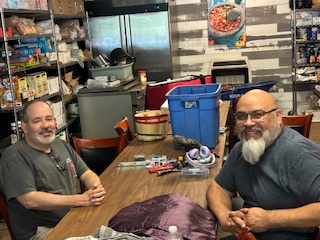
Photo by Wendy Welch
Davis went to Latin Appalachian the Tuesday after the floods, both to get a hot meal and to check on his friend Diaz.
Davis said people had sometimes spoken with him about a negative connotation of the flood as God sending a wake-up call. “Well, I came in here – there were Red Cross volunteers in here, a Red Cross chaplain was in here, several folks sitting around eating and talking. This whole thing that transpired in this space was sacred and it was a divine act. This is the way that community, that society is supposed to be always, not just in a disaster.”
Davis said that is the way he sees the flood; if it had to happen, it was an opportunity to show God’s love to each other, as had been happening at Latin Appalachian.
That was the first week. It was week four or so when the soup pots at Latin Appalachian gave up and blew out.
Diaz described the moment. “They literally warped up, blew out, and soup went flying everywhere.”
Diaz may or may not have cried when the pots buckled from constant use. It felt shattering in a personal way. His family had worked hard not to go into debt opening their dream restaurant.
“Like if it was one spoon, we saved enough to buy a spoon. If it was a fridge, we saved to buy a fridge. When they blew out, it was just an emotional thing, like it was something we worked hard for that was another thing we were bearing,” Diaz said.
Sam’s Club walked in with new pots the day after Diaz live-streamed the loss. They also brought a check to pay the electric bill. Latin Appalachian had been running full tilt for weeks without taking in cash. For the restaurant. Diaz had received plenty of monetary donations, but these had all gone to help churches and community groups pay for essentials.
Meanwhile, Latin Appalachian still had a basement full of mud.

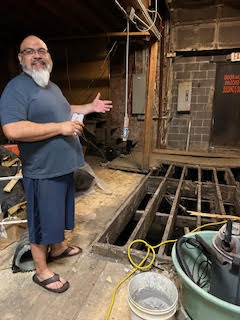
Photo by Wendy Welch
“I went to the back on week four, and I was down there myself, and I stand in the mud looking at it, and I was like, this was the realization of this may have been the very last hurrah or push of what this business was used for, for relief,” Diaz said. “There’s no FEMA relief for businesses, the only relief there is, is they do a FEMA SBA loan for us. So we have to go into debt.”
The loan was approved, but Latin Appalachian had grandfathered-in equipment that would require upgrading.
Diaz said, “In order to reopen we have to do a whole new suppression system, a hood system. And that’s about $20,000. Almost our entire half of our loan is taken up by just that one unit.”
Ironically, the community that wanted to help as they had been helped, couldn’t. GoFundMe campaigns can disqualify FEMA loans. So the family bought a food truck. They intend to earn revenue to reopen the bricks and mortar restaurant.
Diaz is optimistic–and determined. “Whether it’s six months a year, I’ll reopen; it’ll get there. One board, one nail at a time, I’ll do it, I’ll get there.”
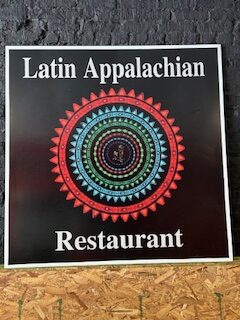
Photo by Wendy Welch
For his birthday not long after the flood, Diaz received a new shop sign with Latin Appalachian’s name and logo. He keeps it propped up in the closed restaurant, “a literal sign that we will reopen.”