
Your browser doesn't support audio playback.
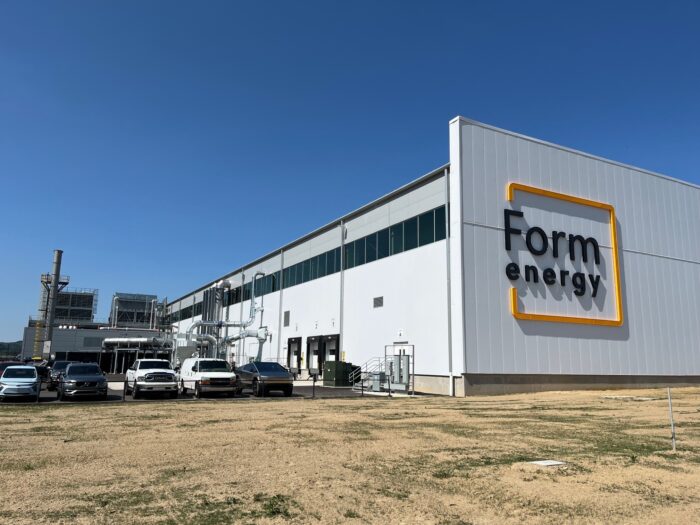
Form Energy opened its battery factory last year in Weirton.
Curtis Tate spoke with Form co-founder and CEO Mateo Jaramillo about where the company’s product will be installed first and how it fared in recent federal tax legislation.
This interview has been edited for length and clarity.
Tate: Have you delivered any batteries yet?
Jaramillo: The first project that will deliver is, and has always been, the project with Great River Energy, which is the one in Minnesota. It’s the generation transmission cooperative there in Minnesota. The site is in Cambridge, Minnesota. The site is being built out right now. So we have landed our first pieces of gear there. That’s the power electronics and some of the common ancillary systems. We are laying the foundations. We’re pouring the foundations. We’re running the conduit on site right now. And we are building up the batteries that we will deliver to the sites over the remainder of the summer, and we’ll start later this summer, with the deliveries there. That’s a little behind what we had been forecasting previously.
Tate: So you’ve had some bumps in the road?
Jaramillo: You know, starting up a factory is challenging, and we have 800 parts of the build materials, and any one of them can trip you up from a specific timing standpoint. So we’re working through very normal, solvable challenges, but ones that we have to work through. We’re working through that. And the lines are running, we’re building up material in the meantime that will then all get put into the enclosures and shipped out. But we are a little bit behind, and so we’re working to sort of resolve all that as quickly as we can, and we still feel good about delivering those first projects, or first batteries to the customer, this year and then the bulk of the deliveries will start next year, actually.
Tate: How did you fare under the recently passed budget bill? Did you keep the tax credits?
Jaramillo: The ones that really matter for us are what are called the investment tax credit. That’s for the projects that are deployed, and those are the credits our customers would claim. That’s sort of a demand signal, if you will. And then on the other side of it is a manufacturing production tax credit. So for making batteries in the United States, there’s a beneficiary and production tax credit, and that’s the one that we would claim the provisions actually remain unchanged from the (Inflation Reduction Act) through the (budget bill). So we’re very pleased to see that the new Congress and the new administration is very supportive of battery manufacturing in the United States, and in particular, battery manufacturing that has no reliance on what are called foreign entities of concern.
Tate: Can you explain that?
Jaramillo: Form batteries are 85% domestic content already, and have been for a long time. The 15% that’s non-U.S. comes predominantly from Europe and non-China Asia. So we had little to no, and now, no exposure to China anyway. Those are very manageable sort of provisions that got added on top of that, the requirements to be compliant with no FIOC materials in the system. So we feel actually pretty good about that.
Tate: Where does storage fit into the big picture?
Jaramillo: I think what’s another high level takeaway that is important is storage is becoming increasingly recognized as really a part of the suite of technologies that provides a lot of reliability to the electric system. And so they were, storage, in particular, was carved out alongside geothermal and nuclear as specifically qualifying for this investment tax credit, for the demand side support, if you will, precisely because it really drives a lot of reliability in the system and what are called baseload technologies. That being recognized is great, and we had a lot of direct engagement across the federal government, certainly with our representatives here in West Virginia.
Tate: So your concerns were heard, then?
Jaramillo: Here in West Virginia, but even much more broadly than that, and it was a fairly easy story to tell that storage supports the electric grid in this moment of massive demand growth that we have and increasing reliability challenges due to weather volatility events, while keeping costs low. The imperative for the electric system is that we need to be able to deliver cost effective electricity to everybody. Storage being recognized as a key technology to enable that, going forward, for the grid, for the next 10 years, is really important, and we’re happy to see that legislation reflected.
Tate: How can storage support existing renewables?
Jaramillo: There’s so much installed base of renewables already. What storage can do is increase the value of those existing assets. So roughly 800 gigawatts of installed renewable generation. I should check my number on that one, but many hundreds of gigawatts are being installed already, and how to make sure that those are as utilized as possible, right? And additionally, I think the solar industry will figure things out pretty quickly and be deployed at large volumes, continuing going forward, simply because it’s very cost effective to bring that technology online and you can build it at scale very quickly.
Tate: What’s the biggest challenge in the grid going forward?
Jaramillo: One of the imperatives here is to bring as much capacity online as quickly as possible. And some of the newer generation technologies, the next generation of nuclear, for example, won’t come online for roughly a decade. Additionally, there’s a real supply crunch on gas turbines right now. Solar is widely available. It can be deployed at scale. And I think that will drive it considerably going forward.