
Your browser doesn't support audio playback.
Five county school superintendents presented a review of the state’s Public Education Code to the Joint Standing Committee on Education Sunday.
Their recommendations ranged from facilitating student certification in career and technical programs, to adjustments to the school funding formula.
Will Hosaflook, superintendent of Jackson County Schools, told the lawmakers they welcomed the opportunity to be part of a solution.
“We are willing to spend as much time as necessary with you to help solve the barriers of West Virginia laws and policies that prohibit students from reaching their potential in our school systems,” he said.
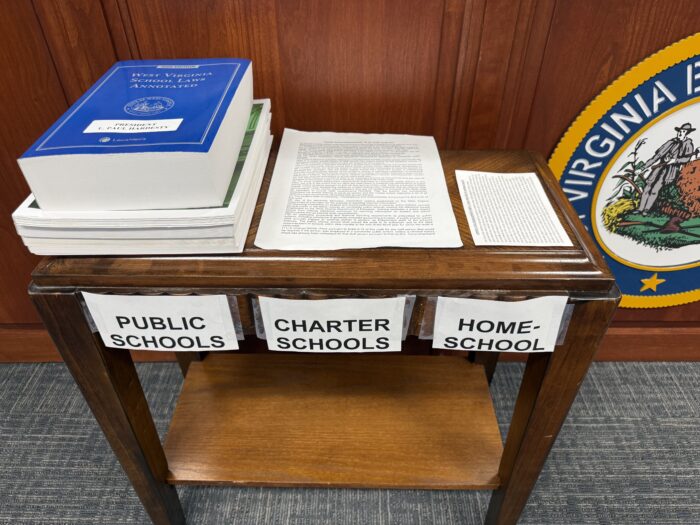
Paul Hardesty, president of the state Board of Education, recently drew attention to the complexity of the state’s regulations for public education after he compared the more than 1300 pages of state code for public schools to the one page of requirements for public charter schools and a single index card of rules for homeschooling.
Hosaflook opened suggestions by outlining how graduation requirements limited students from pursuing more than one professional certification before leaving high school. He asked for changes in code to allow greater flexibility in educational pathways.
“Why are we forcing our public education students to take one credit of computer science?” Hosaflook said. “We have stolen one class away from the welder, away from the electrician, away from the carpenter, away from the future teacher. That’s the only thing we’ve done, because we are limited by time. We are limited by credits. There are only eight periods in a day in most high schools, we are limited.”
Tim Hardesty, superintendent of Cabell County Schools, tackled the school funding formula, a topic that has drawn much legislative attention in recent years. The formula has not been changed in several years, and its complexity has made many lawmakers leery of taking it on in a 60 day session.
Hardesty presented what he said was a simple solution to the state’s dwindling enrollment with higher rates of special needs: add three professional personnel and three service personnel to the calculations for each district.
“We realize that is a large fiscal note, but if the cost of three additional professional personnel and service personnel added to all levels in these two portions of code would cost approximately $95 million,” he said. “We base that on an average cost of $80,000 for professional position, $50,000 for service position, although actual calculations would need to take place.”
The state legislature has discussed an ongoing teacher shortage of close to 2000 professionals for several years, repeatedly extending provisions such as the rehiring of retirees as a stopgap measure. Recently, shortages in staff positions such as bus drivers and custodians have also required legislative attention, but to little avail.
Several of the other proposals for code changes also related to greater flexibility for districts to move staff more freely to address such shortages.