



Your browser doesn't support audio playback.
Kids in urban zip codes are more than twice as likely to use the Hope Scholarship than rural kids, with 4.7% participation rate in urban zip codes and 2.1% participation in rural zip codes.
That’s according to a new analysis of state sponsored voucher-style scholarships by The Associated Press (AP) out this week. The AP zoomed in on Texas — the latest state to commit major funding — but also analyzed data out of states like West Virginia with private school choice programs.
The state’s five most populous counties: Kanawha, Berkeley, Monongalia, Cabell and Wood accounted for more than a third of all Hope Scholarship recipients during the 2024-2025 school year.
Starting in March, existing private school and traditional homeschool students became eligible to participate in the state’s Education Savings Account program. Previously, the state’s school voucher program required students to be enrolled in public school for at least 45 days to be approved. The Hope Scholarship program provides financial assistance to qualifying families of K-12 students to be used for tuition, homeschool curriculum and other approved educational expenses.

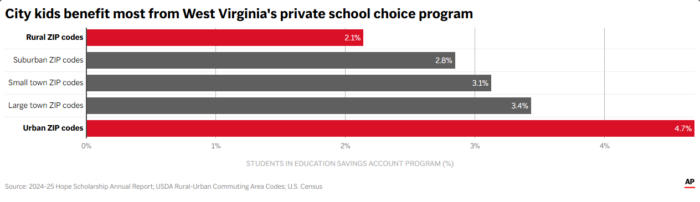
Photo Credit: Courtesy of AP
The AP’s analysis found that students who are already enrolled in a private or home school are most likely to take advantage of these funds. In West Virginia, Hope Scholarship leaders have already reported a near doubling of applications since last year.
With more than 25,000 students starting applications for fully funded Hope Scholarships for the 2026-2027 school year, and a maximum award of $5,435.62, West Virginia’s Hope Scholarship spending could jump above $135 million.
At just over 5%, the Hope Scholarship program still represents a small sector of the state’s educational landscape. But the data shows that the start of the scholarship in 2022 accelerated an existing decline in public school enrollment.
In the 20 years between the 2001-2002 school year and the 2020-2021 school year, public school enrollment in West Virginia fell 2.1% from 93% of all students to 90.9%. In the past five years alone, public school enrollment has fallen 2.4% to 88.5%.